Where does Colorado Parks and Wildlife’s revenue come from?
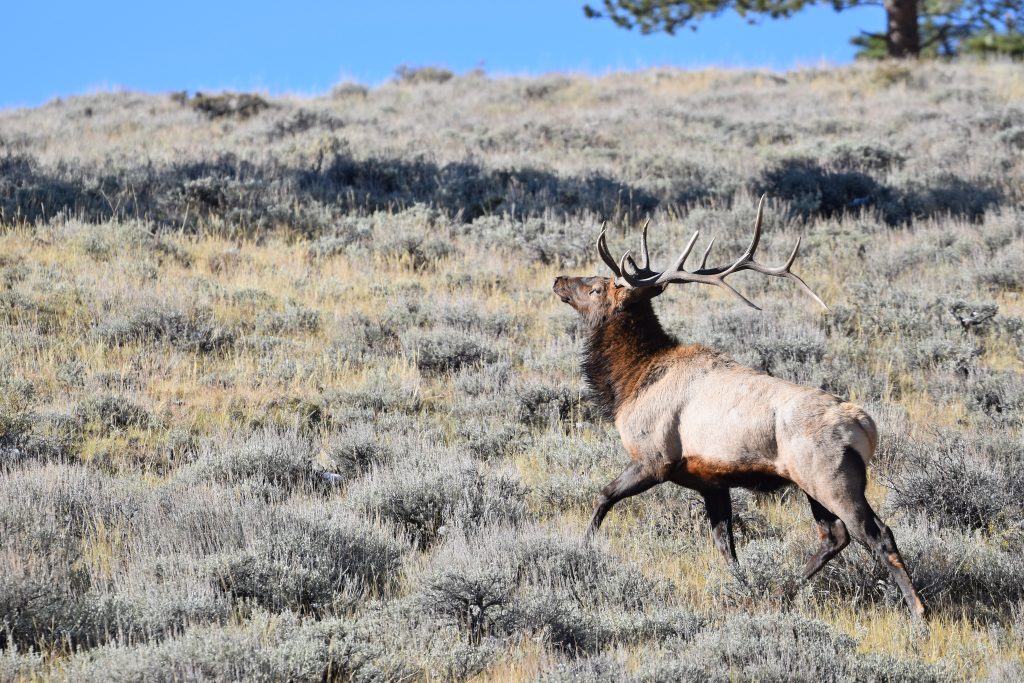
Wayne D. Lewis, Colorado Parks and Wildlife/Courtesy Photo
As Colorado legislators commenced the annual budgeting process this winter, their first review of the state’s Department of Natural Resources budget for the upcoming fiscal year was dominated by wolves.
However, the state’s gray wolf reintroduction program is a unique line item for Colorado Parks and Wildlife — the enterprise agency that falls under the Department of Natural Resources.
While the wolf program is supported annually with a $2.1 million allocation — reduced by $264,268 in the current 2025-26 fiscal year during a special legislative session in August — from Colorado’s general fund, it is pretty much the only Parks and Wildlife program to receive this type of allocation from the state.
During the 2025-26 fiscal year, Parks and Wildlife received 3.5% — equivalent to around $1.9 million — of the Colorado Department of Natural Resources’ $57.08 million general fund allocation, according to a Dec. 9 Joint Budget Committee budget briefing.
The majority of the department’s general fund dollars went toward the Colorado Division of Water Resources (48.5% ), the executive director’s office (29.9%) and the Division of Forestry (18.1%).
Despite this, Parks and Wildlife has a larger budget than the divisions under the natural resource department — funded primarily by hunting and fishing licenses, state park passes and other fees.
In the most recent fiscal year, non-resident elk licenses provided the most revenue to the wildlife agency’s Wildlife Cash Fund — bringing in around $45 million, despite representing less than 5% of total licenses sold.
A non-resident elk adult hunting license was $825.03 in the most recent hunting season, compared to $67.86 for an adult Colorado resident. According to the joint budget committee report, resident elk hunting licenses brought in over $5 million in the latest fiscal year and represented just over 5% of the agency’s license sales.
Parks and Wildlife sells more fishing licenses — representing over 55% of its license sales in the 2025-26 fiscal year — than any other license type. The fishing licenses brought in around $25 million during.
These hunting and fishing license sales — as well as other passes and fees — make up over half (58%) of Parks and Wildlife’s annual revenue.
Revenue from hunting and fishing licenses goes toward the Wildlife Cash Fund, which funds the majority of its wildlife work. In the 2025-26 fiscal year, over $150 million was appropriated to this cash fund.
The agency’s second-largest cash fund is its Parks and Outdoor Recreation Fund, which receives allocations from state parks passes, camping fees and more. This fund is used for state park management. Just over $77 million was appropriated to this fund in the most recent fiscal year.
“Historically, the fund has received most of its revenue from campsite fees, annual parks passes, and parks day passes,” said Kelly Shen, the joint budget committee staff member who presented the department briefing to lawmakers on Dec. 9.
Shen reported that this has changed as state park visitation has increased — from around 14 million in the 2015-16 fiscal year to just under 20 million in the 2024-25 fiscal year — and as the state introduced the Keep Colorado Pass.
“For the past five years, a lot of this license pass revenue has been the largest share of revenue for Parks funds,” she said.
The Keep Colorado Wild Pass was created in 2021 by the state legislature to generate additional revenue for Parks and Wildlife to use for state park maintenance, local search-and-rescue organizations, and the Colorado Avalanche Information Center. It launched in 2023, granting access to all Colorado state parks for a $29 fee on annual vehicle registrations. A traditional state park pass costs $80 annually.
In the latest fiscal year, the pass brought in $41 million for the agency, a 3.3% increase from the pass’s first year. However, the increase in these sales has come with a decline in annual and daily pass sales. In an August presentation to Parks and Wildlife’s Commission, Justin Rutter, the agency’s chief financial officer, reported that sales from the annual and daily passes were down 19%, representing a decrease of $2.1 million in revenue.
Both cash funds receive significant revenue from lottery proceeds, Great Outdoors Colorado grants and federal funds. Parks and Wildlife receives 10% of net lottery proceeds for state park maintenance and improvement as well as another 50% of net lottery proceeds allocated to the Great Outdoors Colorado trust, which goes toward both wildlife and park programs.
Lottery proceeds are a significant source for the Parks Cash Fund, representing 12% of the total revenue in 2024-25, according to Parks and Wildlife. Great Outdoors Colorado grants represented 16% of parks’ revenue in the same fiscal year.
The joint budget committee report noted that the Wildlife Cash Fund receives between $30 to $40 million annually in federal funding, largely from federal taxes on firearms as well as archery and fishing equipment. Parks and Wildlife reported these federal dollars as the second largest revenue source for wildlife programs after licenses in 2024-25, representing 17% of its revenue. Great Outdoors Colorado grants represented around 5% of its wildlife-related revenue.
Across Parks and Wildlife, the majority of its money is spent on staff and operational costs.
According to the joint budget report, wildlife operations is the largest line item in the Department of Natural Resources’ budget. At $134.2 million in the 2025-26 fiscal year, it represents 25% of the department’s appropriations and over 40% of the staff positions, with around 731 full-time staff positions. The report indicates that the largest share of these expenditures is going toward salaries for wildlife manager and technician staff positions.
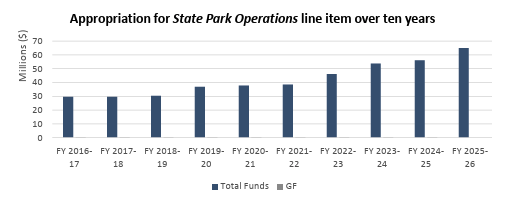
After wildlife operations, state park operations are the second-largest line item in the Department’s budget, with a $64.8 million appropriation in the 2025-26 fiscal year and around 332 full-time staff positions. While most of the expenditures are for staffing costs, Shen noted that “operating expenses are smaller but still a large part of spending” when it comes to Colorado’s state parks.
“Over the past 10 years, park visitation has generally increased, sort of peaking during the pandemic and sort of climbing back up again now,” Shen said. “This increased use of the parks requires more cleaning, requires landscape restoration, equipment repairs, toilet paper, garbage bags — those day-to-day operational things. So that’s also contributing towards some of the increased appropriation.”
Colorado has 43 state parks. Chatfield, Cherry Creek, Golden Gate, Lake Pueblo and Arkansas Headwaters state parks — located closer to urban population centers — have the most visitors each year, according to parks data collected by Parks and Wildlife. Pearl Lake, Harvey Gap, Fishers Peak, Lone Mesa, Paonia, Mancos and Sweitzer Lake state parks are among the least visited historically.
In an email to the Vail Daily in September, Travis Duncan, a public information officer for Parks and Wildlife, wrote that the agency “operates State Parks as a system, not as individual businesses.”
“The resources at rural, naturally significant parks may generate less revenue than urban, water-based parks, but are still a valuable resource,” Duncan wrote. “Ultimately, when you calculate all direct and indirect expenses attributable to an individual park (especially capital investment), no park is profitable.”
Representatives from the Department of Natural Resources and Parks and Wildlife will be back before the Joint Budget Committee in January, answering questions from lawmakers and discussing future budget priorities. The committee and legislature will be looking for places to make reductions and cuts as the state faces another budget shortfall in 2026. The deficit is projected to be around $850 million, slightly less than the $1.2 billion gap lawmakers were faced with in the current fiscal year.



Support Local Journalism
Support Local Journalism
Readers around Steamboat and Routt County make the Steamboat Pilot & Today’s work possible. Your financial contribution supports our efforts to deliver quality, locally relevant journalism.
Now more than ever, your support is critical to help us keep our community informed about the evolving coronavirus pandemic and the impact it is having locally. Every contribution, however large or small, will make a difference.
Each donation will be used exclusively for the development and creation of increased news coverage.