Democratic lawmakers say they did not solicit funds for Vail retreat that is under investigation by state ethics commission
A group of lawmakers, including some from the Western Slope, is accused of violating the state’s gift ban after attending a weekend summit with lobbyists in Vail. An attorney for the group said the event was covered by funds the lawmakers already had on hand through their caucus.

Robert Tann/The Aspen Times
In response to questions from the Colorado Independent Ethics Commission, a group of more than a dozen Democratic state lawmakers said they did nothing wrong when they attended an October retreat with lobbyists at a Vail hotel, which the commission is investigating.
The lawmakers face accusations from the government watchdog nonprofit Colorado Common Cause of violating the state’s gift ban for legislators after they declined to disclose how their retreat was paid for.
The lawmakers are all part of the Opportunity Caucus, which is made up of more moderate Democrats.
The caucus includes Steamboat Springs Rep. Meghan Lukens, who attended the retreat and is among the lawmakers facing a complaint. Frisco Sen. Dylan Roberts, another caucus member, also attended the event but did not stay at the hotel, so he is not facing a complaint.
After Common Cause filed complaints against the lawmakers on Nov. 5, the ethics commission, which is made up of nonpartisan volunteer members, voted unanimously later that month to launch a probe into the matter.
On Thursday, an attorney for the group of lawmakers responded to several of the commission’s questions, asserting that the retreat, including hotel rooms, was legally paid for through Opportunity Caucus funds.
“We knew from the get-go that we had done nothing wrong,” State Sen. Lindsey Daugherty, an Arvada Democrat who chairs the caucus, said in a statement after the responses were filed. “But if you believe in the rule of law, you have to respond seriously even to empty, politically motivated complaints like this.”
What the complaints allege, and how lawmakers responded
Common Cause, in its complaints against the lawmakers, alleged that the retreat violated the state’s gift ban because it had been paid for, at least in part, by a nonprofit that largely does not disclose its donors.
The Colorado Constitution generally limits elected officials from accepting gifts or payments valued at over $75, including for travel and accommodation.
Lawmakers who are scheduled speakers at an event can have their admission covered and accept payments for “reasonable” expenses. A nonprofit that pays for those expenses, however, must receive less than 5% of its funding from for-profit organizations.
Common Cause claimed that the Opportunity Caucus lawmakers, who stayed at the Sonnenalp Hotel in Vail, couldn’t pay the cost of their rooms and asked One Main Street to step in with $25,000.

One Main Street is a business-focused nonprofit that has used its PAC to support more moderate Democratic candidates in state primary elections. It does not fully disclose its donors, with some referring to the nonprofit as a “dark money” group. Because of this, Common Cause claims there’s no way to know if less than 5% of the nonprofit’s funding comes from for-profit groups and that the lack of transparency violates the state’s gift ban.
The complaint filings from Common Cause included screenshots of emails from One Main Street’s executive director requesting “urgent” approval of money from the nonprofit’s board to “secure rooms for the Colorado Opportunity Caucus.” The email states that the hotel rooms for the event are “at risk if payment isn’t made in time” and that the Opportunity Caucus asked One Main Street to “step in with $25,000 so they don’t lose the reservation.”
Common Cause also claimed that the nonprofit paid for the lawmakers’ food and drink. Common Cause said the payments amounted to One Main Street wielding “undisclosed influence over a large number of Colorado legislators by paying significant costs of the event, including their individual travel expenses.”
Responding to questions from the state’s ethics commission about how the retreat was paid for, Mark Grueskin, an attorney representing 15 of the accused lawmakers, said the caucus did not use the $25,000 from One Main Street to cover their expenses.
Grueskin is a taxpayer-funded attorney for the lawmakers, which is common for legislators who face legal challenges while serving in the legislature. Only one Opportunity Caucus member facing a complaint, Thornton Sen. Kyle Mullica, did not request taxpayer-funded legal services and is responding separately.
Grueskin claims the caucus used funds it already had available to cover lawmakers’ rooms during the retreat, which was held over the Oct. 4 weekend and totaled $19,040. The caucus also covered lawmakers’ food, drink, meeting room rental and overnight parking, with the total cost of the retreat coming to $32,671, according to Grueskin.
Grueskin said the caucus had more than enough money in its bank account to cover the costs before the event. He included an affidavit from a banker at FirstBank, which the caucus uses, who stated that the caucus did receive a wire transfer of $25,000 from One Main Street on Sept. 5, but that it already had $33,853 in its account at the time.
The affidavit also included the following details:
- The Opportunity Caucus opened its account with FirstBank on July 23, 2025.
- The caucus opened its account with a $12,000 deposit from One Main Street.
- A wire transfer for $25,000 was made to the caucus on Sept. 5, but that money did not come from One Main Street.
- A separate $25,000 that did come from One Main Street was made later that same day.
Grueskin said that while a $25,000 donation from One Main Street was made, the complaints from Common Cause assume that “any funds transferred after the email sent by (One Main Street’s) executive director were necessarily the ones that were used to pay for the caucus’s hotel expenses.”
Grueskin said the caucus’ available funds, which it used to pay for the retreat, were “general, unrestricted donations from permitted sources, specifically one non-profit organization and one individual’s trust.”
Grueskin added that caucus members pay dues to qualify as members, and that Daugherty, the caucus chair, has paid $1,020 in dues to the caucus. The caucus is made up of approximately 18 Democratic lawmakers.
The caucus was formed as a 501(c)(4) nonprofit last year, and as such, is allowed to collect donations and is not legally required to disclose its benefactors. The caucus has so far declined to do so when asked by media outlets.
While the state’s gift ban prohibits direct payments to lawmakers by certain groups, the caucus argues that using general funding from donations to cover its retreat does not fall within the scope of the ban. Grueskin said the caucus also sought legal advice on raising funding for the retreat, and was told that doing so would not violate the gift ban.
Retreat spurs political tension
The Vail retreat has also exacerbated political divides between more moderate and progressive Democratic lawmakers.
Progressives, alongside allied groups like the Working Families Party, have been critical of both the Opportunity Caucus’ lack of disclosure over how the retreat was funded, as well as the purpose of the event.
The retreat was attended by lobbyists whose clients include Xcel Energy, the Colorado Association of Realtors and GEO Group, a private prison contractor, according to reporting by The Colorado Sun.
Progressives have framed the retreat as a back-door meeting with powerful interest groups that they say hurts the Democratic Party’s image with voters, especially at a time when the party’s popularity is suffering nationwide.
Rep. Elizabeth Velasco, a Glenwood Springs Democrat considered to be among the legislature’s more progressive members, called the retreat a “major flag, and I think it’s a bad look for Democrats right now,” when asked about it in October.
Progressives have also raised concerns with the caucus’ ties to One Main Street since that group has funded moderate Democratic candidates over progressives in some state races.
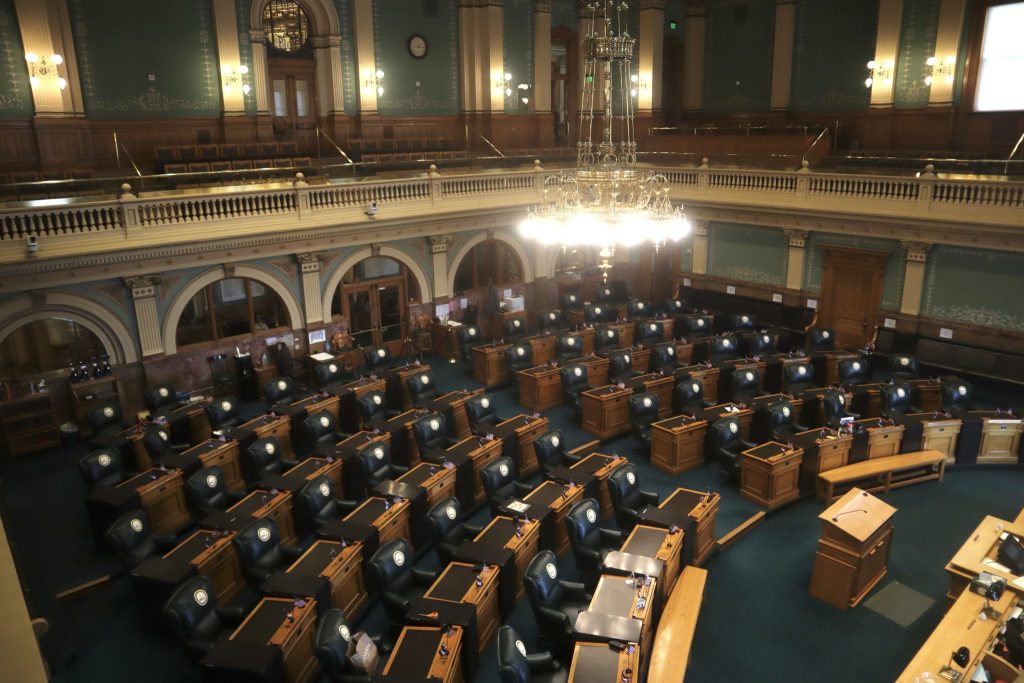
Opportunity Caucus members, however, said the retreat was purely educational and meant to help lawmakers deal with the issue of voter dissatisfaction by coming together to focus on solutions for Coloradans.
Grueskin, in his response to the ethics committee’s questions, said the retreat featured panel discussions on current legislative topics like health care, education, and artificial intelligence.
“Legislators actively participated in these discussions for purposes of developing insights and expertise that would be useful in their future legislative activities,” Grueskin stated. “Certain caucus members also served on or moderated educational panels for the other members and guests who were included in these discussions.”
The Opportunity Caucus has also accused Common Cause of filing complaints for its own gain. Daugherty, in her statement, said the group has launched “a media and fundraising tour” based on the complaints, which she said are “factually false.”
“Our focus is not on this distraction and it never has been,” Daugherty said. “We know we’ve done nothing wrong, and our attention is squarely on what matters … addressing the affordability crisis that is impacting all Coloradans and their families.”
Leaders with Colorado Common Cause, during a Nov. 21 virtual call with reporters, defended their complaints against the lawmakers and their fundraising efforts.
“The way in which nonprofits raise their money is by fundraising, not unlike political candidates,” said Omar Noureldin, Colorado Common Cause senior vice president of policy and litigation, “and here, we’re fundraising off of the work that our members and our supporters and our donors expect us to do.”
The Opportunity Caucus has also pushed for Common Cause to withdraw its complaints, and the two groups have been in talks about reaching a settlement.
The caucus in November donated $25,000 — the amount they are accused of receiving to cover their retreat — to Food Bank of the Rockies in what they said was a good-faith attempt to remedy trust.
Colorado Common Cause Executive Director Aly Belknap, during the Nov. 21 call with reporters, said the group wants to see the lawmakers “voluntarily acknowledging mishandling and making it right” as part of any settlement agreement.
The Colorado Independent Ethics Commission will continue to investigate the complaints, and it’s unknown how long it could take for a verdict to be made if a settlement between the two groups is not reached first.










Support Local Journalism
Support Local Journalism
Readers around Steamboat and Routt County make the Steamboat Pilot & Today’s work possible. Your financial contribution supports our efforts to deliver quality, locally relevant journalism.
Now more than ever, your support is critical to help us keep our community informed about the evolving coronavirus pandemic and the impact it is having locally. Every contribution, however large or small, will make a difference.
Each donation will be used exclusively for the development and creation of increased news coverage.