A new petition wants to make it more difficult to kill wolves attacking livestock in Colorado
This is the second petition Colorado Parks and Wildlife has received in 2026 from wolf advocates seeking changes to wolf reintroduction protocol

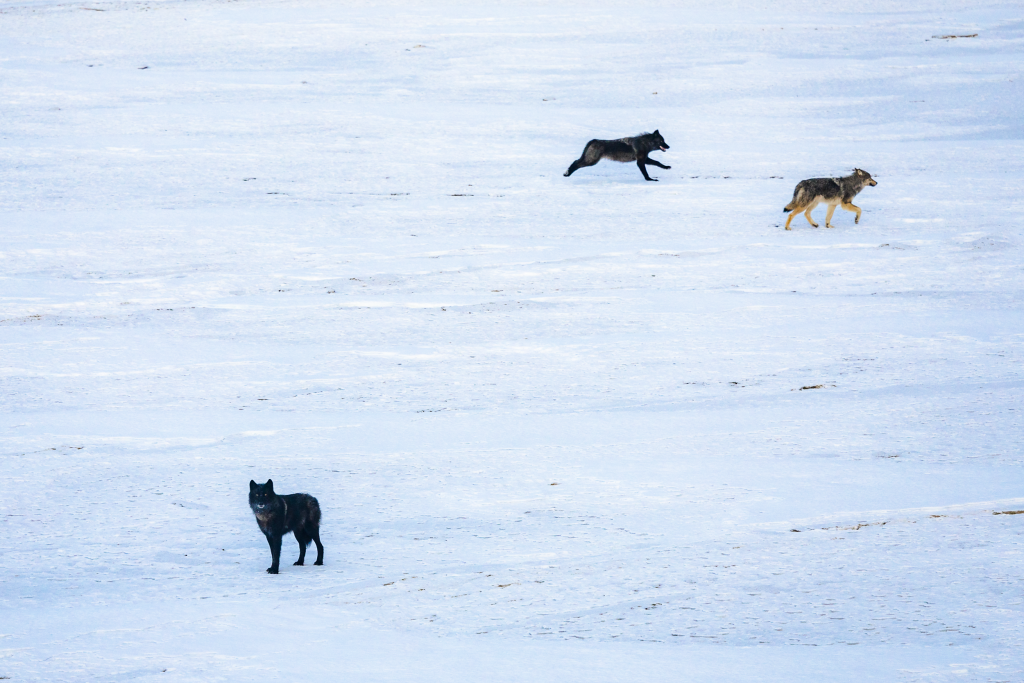
Colorado Parks and Wildlife/Courtesy photo
An environmental nonprofit wants Colorado Parks and Wildlife to have stricter rules guiding when wolves responsible for repeated livestock attacks can be killed.
The Center for Biological Diversity submitted a citizen petition to the state agency on March 9, just under a week after the nonprofit’s petition seeking to ban the commercial sale of furs in Colorado was approved by the Parks and Wildlife Commission against the recommendation of agency staff. Approval of a citizen petition does not immediately grant the petition’s request, but it initiates a rulemaking hearing where proposed changes can be considered by the commission.
Alli Henderson, the nonprofit’s Southern Rockies director who submitted the petition, said the request is all about transparency and consistency.
“Clear rules around these critical management decisions protect everyone,” Henderson said. “They give livestock operators clarity about how these decisions are made and the expectations for these severe decisions, provide CPW with defensible decision-making standards and give the public confidence that decisions to kill wolves are not made prematurely or inconsistently. Most importantly, they honor the intent of wolf reintroduction by ensuring that if the agency authorizes killing wolves, it’s genuinely a last resort and not a substitute for prevention and mitigation.”
This is the second citizen petition regarding wolves that Parks and Wildlife has received this year. In February, 19 wolf and wildlife advocacy organizations, as well as 164 individuals, submitted a petition seeking to make changes to how the agency compensates ranchers for livestock losses caused by wolves.
Producers, however, are concerned that the changes will make things more challenging.
“After what we experienced with the furbearer petition and with the now two wolf-related petitions, we’re really fearful about what’s to come and that it will ultimately take tools out of producers’ toolboxes to manage wolves,” said Erin Karney Spaur, the executive vice president of the Colorado Cattleman’s Association.
When does Colorado kill wolves attacking livestock?
Gray wolves are federally listed as endangered in Colorado. When Parks and Wildlife began its reintroduction of the species in December 2023, it obtained a special rule from the U.S. Fish and Wildlife Service to be able to kill wolves that were repeatedly killing livestock.
In December 2024, Parks and Wildlife released a definition of chronic depredation and outlined when it would consider killing a wolf or wolves that developed a pattern of killing livestock. Under this, “chronic depredation” refers to a wolf or wolves connected to three or more depredation events within 30 days. Depredation events can include any physical attack resulting in injury or death to livestock or dogs. At least one of three events must have “clear and convincing evidence” that it was caused by a wolf.
This management directive asks Parks and Wildlife to consider four things in determining whether to kill a chronically depredating wolf:
- Whether there is documentation that the wolf or wolves were repeatedly killing and harassing a producer’s livestock or working dogs
- Whether a variety of nonlethal conflict minimization materials and techniques were attempted
- The likelihood that the wolf or wolves will continue to kill livestock if not killed
- Whether the wolf or wolves were lured or baited to the area — intentionally or not
While Parks and Wildlife staff can lethally remove wolves, it can also grant a chronic depredation permit if state and federal agencies lack the capacity.
Since the reintroduction of gray wolves began in December 2023, Parks and Wildlife has killed one chronically depredating wolf: a yearling from the Copper Creek pack tied to repeated cattle attacks in Pitkin County in May.
The agency has also tried, and failed, to kill two other wolves tied to livestock attacks.
After the agency killed the Copper Creek yearling in May, the pack continued to attack livestock in the area, and Parks and Wildlife attempted to locate and kill a second yearling. The agency ended its search in October after failing to locate and euthanize the responsible wolf.
The agency also attempted to kill an uncollared wolf — later identified as a wolf born to the Copper Creek pack in 2024 that was separated from the pack — in Rio Blanco that was tied to multiple sheep deaths in 2025. The wolf was shot during the attempt, but with a body never recovered, it is believed to be alive. Parks and Wildlife announced it made a subsequent search attempt for the uncollared wolf in January.
Parks and Wildlife did not respond to a request regarding how many Colorado producers have requested chronic depredation permits and whether it has granted any. According to its two annual wolf reports, it received and denied one request for a chronic depredation permit between December 2023 and March 31, 2025.
What is the petition asking for?
According to Henderson, the Center for Biological Diversity aims to add clarity to this process.
“Without clear rules, the public and livestock operators have no shared understanding of what’s required to obtain depredation permits or what compels the agency to kill wolves,” she said. “These decisions risk appearing arbitrary, politically driven or disconnected from science.”
The petition proposes requiring written documentation of lethal removal determinations before operations begin, stricter and more specific standards around the “reasonable” use of non-lethal conflict minimization tools to prevent wolf-livestock attacks and to shorten the length of chronic depredation permits from 45 days to 30 days.
While current regulations require Parks and Wildlife to consider whether wolves were lured to the area, the petition requests specific language be added about the removal of carcasses.
“Improperly managed carcasses are powerful attractants, conditioning wolves to associate livestock operations with food and increasing the likelihood of depredation events,” Henderson said. “Prompt removal or secure management of carcasses breaks that cycle and is key to preventing it in the first place.”
Spaur said that every producer she speaks with is “willing to apply nonlethal tools, where appropriate, and where they believe will work.”
The challenge with these tools — including range riding, fladry, scare devices and more — is that they are effective in some circumstances and, in other circumstances, fail or have an expiration date of effectiveness, she added.
“In our viewpoint, producers are deploying nonlethals where appropriate, but what we’re asking for in return for that is if a wolf is depredating on livestock, that that (lethal removal) tool remains,” Spaur said. “I think adding all of these qualifiers or whatever you want to call them, just continues to move the goalposts, so ultimately, chronic depredation permits are not deployed because it’s such a high threshold that you have to be.”
Chance Jenkins, a Garfield County rancher and president of the Holy Cross Stockgrowers Association, referred to it as another attempt by the “extreme left, environmental NGOs” to move these goalposts set in conjunction with agricultural stakeholders and experts when Colorado created its final wolf plan. Jenkins said that this attempt to change the requirements for chronic depredation permits is because every chronic depredating wolf is “bad publicity for them and their cause.”
“For any plan to work, the plan has to be held to,” he said. “Granted, there may need to be minor adjustments, but they’re trying to adjust things because these depredation claims are coming in wildly over what they had budgeted or sold to the public. It’s more of the goalposts moving.”
He added that for the agricultural industry to want to “actively participate and contribute to the program, we have to believe that it will work, and we have to believe in its intent” — something he claimed is hard to do when trust is eroding between producers and the agency leadership and when these goalposts are constantly being moved.
“Am I saying anything’s gonna happen? No,” Jenkins said. “We’re going to continue to do what we’ve done: Take care of our cattle, be stewards of the land we run on and continue to protect our property.”
Henderson argued that these changes are more necessary following Parks and Wildlife’s announcement that it would not release additional wolves this winter.
“We need to set Colorado up for success at this pivotal moment in the wolf restoration program,” she said. “With uncertainty around additional wolf releases due to federal actions, the margin for error is especially slim. Every management decision matters when the population is small and still establishing.”
The agency made the decision to pause releases after it was unable to find a source for wolves this winter, after a change in U.S. Fish and Wildlife Service leadership and direction prohibited Parks and Wildlife from returning to British Columbia as planned. Parks and Wildlife captured and released 15 wolves from the Canadian province in January 2025. While there have been new wolves born, 12 of the 25 wolves reintroduced to Colorado have died.
“Colorado’s wolf population is small, vulnerable and still establishing, so the stakes of killing wolves are especially high,” Henderson said. “Updating CPW’s conflict rules now — before patterns are entrenched — is our best chance to reduce conflict, protect livestock and give wolf restoration a durable path forward.”






Support Local Journalism
Support Local Journalism
Readers around Steamboat and Routt County make the Steamboat Pilot & Today’s work possible. Your financial contribution supports our efforts to deliver quality, locally relevant journalism.
Now more than ever, your support is critical to help us keep our community informed about the evolving coronavirus pandemic and the impact it is having locally. Every contribution, however large or small, will make a difference.
Each donation will be used exclusively for the development and creation of increased news coverage.