Colorado River forecast warns that just one-third of normal water could flow to Lake Powell
The Colorado River Headwaters region that includes Summit, Grand, Eagle, Routt and Pitkin counties has some of the ‘worst’ conditions in the entire 246,000-square-mile Colorado River Basin


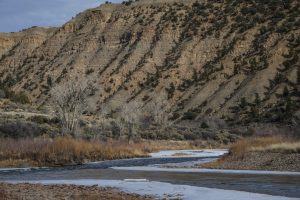
Chris Dillmann/Vail Daily archive
As a record-hot winter continues across much of the West, forecasters are dialing back estimates for how much water will flow into the Colorado River during the spring runoff.
The latest models show that the Colorado River is projected to deliver only about 2.3 million acre feet of water — about one-third of normal — to Lake Powell, the nation’s second-largest reservoir, this summer.
Colorado River Basin Forecast Center hydrologist Cody Moser said during a water briefing this week that if those projections were to bear out, that would be the fifth lowest amount of water delivered to Lake Powell in the past 63 years.
And water supply forecasts are likely to only get worse before they get better.
“I anticipate this water supply forecast trending lower, at least during the next two weeks,” Moser said, noting that forecasts are pointing to an extended dry spell across the Colorado River Basin.
The Colorado River Basin spans seven states and serves as the water supply for 40 million people. Lake Powell acts as a “bank account” of water that Lower Basin states can draw from during dry years and Upper Basin states add to after using their share of the Colorado River, according to the U.S. Bureau of Reclamation. The reservoir, and the Colorado River in general, have experienced ongoing shortages amid a water crisis in recent years.
The hot weather and low snowpack this winter have prompted water shortage concerns at a critical juncture. The Colorado River Basin states failed to reach an agreement by a critical deadline last month, kicking the question of how to manage the river and its important reservoir system to the federal government.
Across the entire Colorado River Basin, total precipitation this winter trended closely with last season, Moser said. While river basins in southern Wyoming and central Arizona have had above-normal precipitation since October, he said other regions have trended below average. The Colorado River Headwaters region in particular has stood out for having poor precipitation this winter.
“This area is doing the worst this water year,” Moser said of the Colorado River Headwaters region that includes much of northwest Colorado, including Grand, Summit, Eagle, Pitkin and Routt counties.
In the Colorado River Headwaters region, river basins have received only about 70% of average precipitation since October, some of the lowest levels of precipitation anywhere in the 246,000-square-mile Colorado River Basin, according to National Oceanic and Atmospheric Administration data.

While precipitation in the Colorado River Basin as a whole wasn’t as bad as it was in the Headwaters region, Moser said temperatures across the entire basin have been several degrees above normal through nearly the entire winter.
Due to the warm temperatures, he said many locations accustomed to receiving the bulk of their winter precipitation as snow have instead had more rain and snow has been melting at locations as high as 10,000 feet.
“It has been a very warm winter and that has had a significant impact on snowpack accumulation,” Moser said, noting that the snow-water equivalent in the Colorado River Basin above Lake Powell is only about half of normal.
The Colorado River Headwaters region has a similarly low snowpack, with the Eagle River Basin at 42% of normal, the Roaring Fork Basin at 49% of normal, and the mountains above Kremmling at 53% of normal, according to the data.
The melting snow and rain has also led to changes in soil moisture. While soil moisture throughout much of the Upper Colorado River Basin, including the Headwaters region, was below average in November, Moser noted that as of March 1 it was above-average in many parts of the basin.
While above-normal soil moisture is typically considered a good thing because dry soils soak up more of the spring runoff before it can reach streams and reservoirs, Moser said that is not the case this year, since the soils are wet due to melting snow and rain.

“While it’s nice to see above-average soil moisture conditions, think of why that is: We are losing the snowpack and getting rain instead of snow,” Moser said. “So you don’t really want to see these types of soil moisture conditions, above-average, prior to the April through July runoff season, but that is what has happened this winter and spring so far.”
With the low snowpack, seasonal water supply forecasts are well-below normal across the Colorado River Basin. In the Headwaters region, the Eagle River, the Roaring Fork and the Colorado River near Kremmling are all forecast to receive about half of the normal volume of water between April and July, according to the data.
While weather forecasts are calling for more hot, dry weather for the Colorado River Basin over the next two weeks, Moser said how the spring runoff season plays out is far from certain and there is still time for conditions to improve.
“We have five months between now and when the runoff season wraps up,” he said. “So, anything can happen between now and then.”








Support Local Journalism
Support Local Journalism
Readers around Steamboat and Routt County make the Steamboat Pilot & Today’s work possible. Your financial contribution supports our efforts to deliver quality, locally relevant journalism.
Now more than ever, your support is critical to help us keep our community informed about the evolving coronavirus pandemic and the impact it is having locally. Every contribution, however large or small, will make a difference.
Each donation will be used exclusively for the development and creation of increased news coverage.