Colorado Parks and Wildlife ends unsuccessful search for uncollared wolf killing sheep in Rio Blanco County
The agency said it has been working with area producers since July to mitigate conflict between an uncollared wolf and sheep

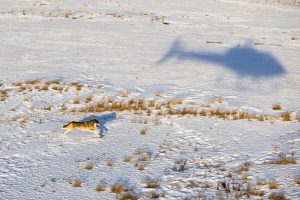
Colorado Parks and Wildlife failed in its latest attempt to locate and kill an uncollared wolf in Rio Blanco County responsible for repeated attacks on livestock.
The wildlife agency announced on Thursday, March 12, that it was suspending a lethal removal effort after looking for the wolf using drones and thermal imaging from Jan. 24 to Feb. 22.
“With no snow on the ground in the area and challenging terrain, we are choosing to suspend this effort,” said Laura Clellan, director of Parks and Wildlife, in a news release “We are grateful to the producers who have been working with us at every step since depredations began in the area in July of 2025 and who have deployed multiple forms of nonlethal conflict mitigation techniques.”
Last summer, an uncollared wolf — later identified via a DNA sample as a wolf born to the Copper Creek Pack in 2024 that was separated from the pack — was responsible for four livestock attacks, involving five lambs and one ewe, on July 20, July 22 and Aug. 2.
As the situation met Parks and Wildlife’s definition of chronic depredation — and efforts by the affected producer to deploy non-lethal tools to reduce conflict — the agency sought to kill the wolf. In the August search, the wolf was shot, but the body was never located.
An uncollared wolf met the definition for a second time in the fall, after being tied to confirmed depredations on Oct. 9, Oct. 12 and Nov. 4 — each involving one sheep. In October, Parks and Wildlife told the Vail Daily that while the depredations were connected to an uncollared wolf, there was no way of confirming whether the responsible animal was the same Copper Creek yearling that was shot in August.
While the agency never publicly announced it was undergoing a lethal removal effort following these attacks, the Coloradoan obtained records from the agency and reported that Parks and Wildlife attempted an operation to kill the responsible wolf in November, but that the effort was suspended by early December. Luke Perkins, a spokesperson for Parks and Wildlife told the Coloradoan that the agency does not produce reports on suspended removal efforts nor does it provide comments on ongoing operations.
According to its online depredation tracker, Parks and Wildlife confirmed an additional wolf attack on 11 sheep in the county on Jan. 24 — the day it began its latest search for the wolf.
Parks and Wildlife is authorized to kill wolves under certain circumstances, including chronic depredation, under its special 10(j) rule from the U.S. Fish and Wildlife Service. Under this rule, the agency has 30 days to remove the animal if warranted. In addition to meeting the definition of chronic depredation, the agency will only seek to euthanize a wolf if a variety of nonlethal tools have been used to mitigate conflict, the wolf was not lured or baited and if it is likely attacks will continue unless action is taken.
In its March news release about the suspended search for the uncollared wolf in Rio Blanco County, Parks and Wildlife reported that the affected producers had conducted site assessments in early 2025. During a site assessment, Parks and Wildlife provides individualized recommendations for which non-lethal tools a producer should deploy to prevent or mitigate conflict between wolves and livestock. According to the release, the Rio Blanco producers worked with Parks and Wildlife starting in July to do the following:
- Increased human presence by CPW Wildlife damage specialists, range riders and herders.
- Night-penning in close proximity to a producer’s home with increased checks during the day and night.
- Opportunistic hazing using scare devices, including air horns, fox lights and propane cannons.
- Producers used guardian dogs in addition to increased human presence







Support Local Journalism
Support Local Journalism
Readers around Steamboat and Routt County make the Steamboat Pilot & Today’s work possible. Your financial contribution supports our efforts to deliver quality, locally relevant journalism.
Now more than ever, your support is critical to help us keep our community informed about the evolving coronavirus pandemic and the impact it is having locally. Every contribution, however large or small, will make a difference.
Each donation will be used exclusively for the development and creation of increased news coverage.