Steamboat Planning Commission votes 3-2 to recommend approval for 12th & Yampa Residences
Mixed-use development proposal from local entrepreneur Collin Kelley now returns to City Council for final decision

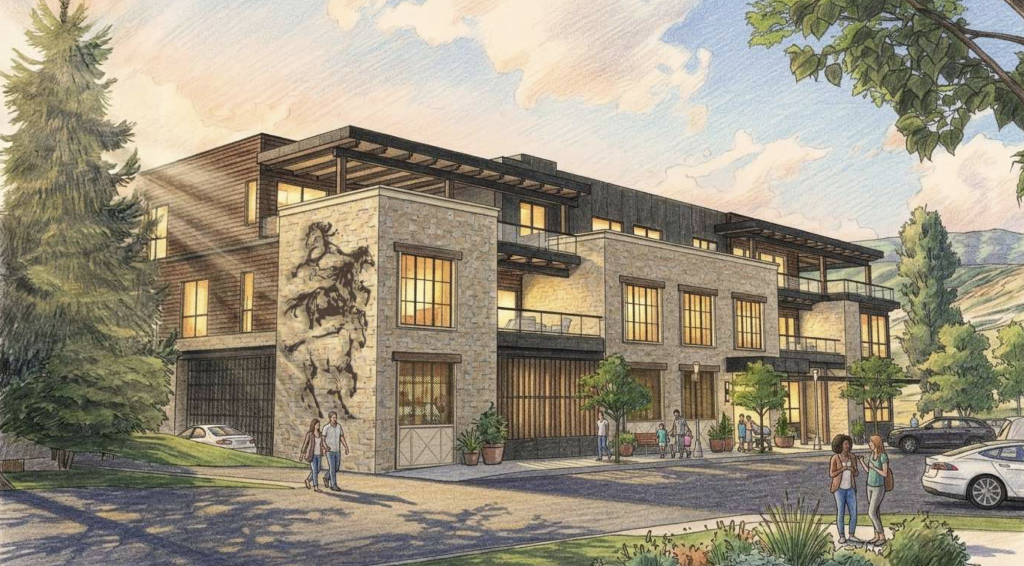
Vertical Arts Architecture/Courtesy photo
The Steamboat Springs Planning Commission on Thursday voted 3-2 to recommend approval of the revised 12th & Yampa Residences project, backing a proposal from local entrepreneur Collin Kelley that has become a flashpoint in the city’s broader debate over downtown character, density and how much weight to give newer planning guidance versus the Community Development Code.
The vote comes roughly two months after the commission voted 2-2 on the project — also known as The Latigo — despite staff’s suggestion for approval, sending it to the Steamboat Springs City Council in April without a clear recommendation.
After a lengthy discussion last month, council then voted 4-3 to remand the project back to the commission, asking for more discussion of the proposal’s nine original variances, the cumulative effect of those requests and a recommendation from a fuller commission, which was absent Commissioners Rich Levy and Lou Tortora in the March meeting.
Since council’s April meeting, over a dozen community members submitted written public comment, both in support of and in opposition to the project.
By the time the project returned to the city Planning Commission agenda on Thursday, the applicant had narrowed the request to six variances, removing requests regarding average plate height, west-side glazing and lot coverage. City staff still recommended approval, saying the project meets the code’s criteria for a development plan and major variance, and the Planing Commission ultimately agreed.
Commissioner AJ Summers recused himself from the Thursday meeting due to his design firm’s involvement with the project, while Commissioner David Box was absent.
The proposed project is located where the former Orange Peel Bicycle Service and Double Z Bar & BBQ establishments — demolished earlier this month — had lived, at the corner of 12th and Yampa streets.
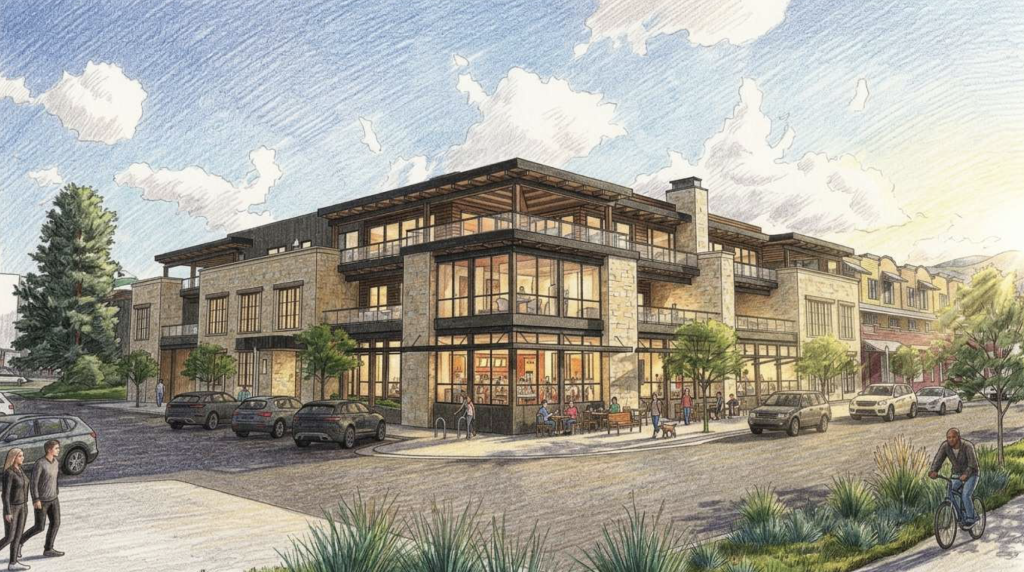
The project proposes a three-story mixed-use building including eight residential condominium units, a ground-floor restaurant, enclosed parking and rooftop space, with some parking available to the public. The corner lot sits next to Waterside Village Condominiums and Little Toots Park and lies within the Yampa River floodplain.
The project remains under the same basic development concept that city leaders reviewed in March and April, but Thursday’s hearing focused more closely on how the revised design responds to earlier criticism from commissioners, councilors and community members alike over scale and massing.
Senior Planner Toby Stauffer told the commission the city’s position had not changed, noting that the project is still consistent with the future plans for the area, even though the city has not yet amended the CDC to reflect those plans.
Sarah Tiedeken, partner at 12th & Yampa’s developer firm Vertical Arts Architecture, opened the discussion by walking commissioners through the revisions.
She said the design team heard the earlier concerns and made visible changes intended to reduce the building’s apparent bulk. Among them: a reduction in lot coverage from 95% to 84%, a reduction in the floor area ratio by 9%, and a slight reduction in the building’s height, thereby eliminating three of the original nine requested variances.
“We heard from you, we heard from council, we heard from the public, and we’ve made a concerted effort to come back to you with a refined, improved project that has some significant changes,” she said.
“We’ve worked so hard with planning (staff), and the approval of this building is fully justified by the existing (code),” said Tiedeken. “We’ve met all the variance criteria. We fit with the direction of the community plan, and the variances exist to allow creative, different ways to think about things, but you still have to meet those criteria.”
“We hope you feel like we listened to you. We really take this to heart,” continued Tiedeken, who noted that she is a longtime local. “We feel really passionate about creating a quality, unique product that can stand the test of time for this important corner.”
Stauffer told the commission the remaining variances were still supportable because the building continues to meet the intent of the code, even if it does not match every dimensional standard exactly.
The project’s location in the floodplain remained a major factor in the height request, while the setback variances were tied to the building’s street-facing design, the need to screen parking and the desire to keep the corner active with a restaurant patio and pedestrian access.
The far side of the building also sits tight to Waterside Village, which staff said helps explain some of the design compromises.
On parking, staff said the project is providing adequate spaces for both the eight residences and the restaurant. The fact that the parking is enclosed rather than placed in a surface lot became part of the discussion around how the building is counted under the city’s floor-area rules, but staff said the plan still fits within the city’s broader downtown framework.
Planning Commission members also wrestled with a broader question that has shadowed the project from the start: How much weight should the city give its newer planning goals when they do not yet match the existing code?
That question came up repeatedly as commissioners discussed the relationship between the Community Development Code and the more aspirational guidance in the Community Canvas and Downtown Plan.
Levy pressed that theme most directly, asking whether the city was effectively relying on uncodified plans to justify a project that would otherwise run into setbacks and massing concerns.
Stauffer said the code remains the governing document, but also acknowledged that the city is in a transitional period, with older standards still in place even as the community’s long-range vision points in a different direction.
Similar to council’s April meeting, public comment was largely supportive of the project, though concerns surfaced again from Waterside Village owners.
Supporters, including a commenter who identified himself as a former planning commissioner for both the town of Silverthorne and Summit County, argued the project would revive an underused corner, add parking, support downtown businesses and generate sales and property tax revenue.
Michelle Caragol, Waterside’s ex-developer, again argued that the Community Canvas is a vision document, not a codified standard, and said the city should not approve a project that requires so many variances.
Waterside Village resident Ralph Pickett voiced his concern that the project would create a wall next to their building and reduce views and openness.
Commission Chair Brian Adams, as well as Tortora and Commissioner Calais Kruse, praised Kelley’s team and city staff for circling back with major revisions in a relatively short timeframe.
“Both to the applicant and to staff … not only redesigning and submitting, but also reviewing so that we could be here tonight as quickly as we are on the project is very impressive,” said Adams. “Well done.”
The Planning Commission ultimately voted 3-2 to recommend The Latigo for City Council approval, with Levy and Commissioner Jonathan Hayek opposed. Hayek recently replaced former Commissioner Gavin O’Toole, whose term expired at the end of March.
The recommendation now brings the proposed development back to City Council, which is set to reconsider the project at its June 2 meeting, according to City Manager Tom Leeson.










Support Local Journalism
Support Local Journalism
Readers around Steamboat and Routt County make the Steamboat Pilot & Today’s work possible. Your financial contribution supports our efforts to deliver quality, locally relevant journalism.
Now more than ever, your support is critical to help us keep our community informed about the evolving coronavirus pandemic and the impact it is having locally. Every contribution, however large or small, will make a difference.
Each donation will be used exclusively for the development and creation of increased news coverage.