Recent poll finds affordability top of mind for Colorado voters, with neither political party popular going into the legislative session
Neither political party has positive favorability despite a blue wave in the 2026 midterm election


Chris Dillmann/Vail Daily archive
Colorado’s “blue wave” elected an unprecedented number of Democrats Nov. 3, but new polling suggests the state’s residents are unhappy with both parties as affordability issues drive voters’ concerns going into the 2027 legislative session.
A nonpartisan poll from the Colorado Polling Institute, which was conducted online from Oct. 30 to Nov. 5, included 606 Colorado voters, with a margin of error of roughly 4%. It found both the Republican and Democratic parties had lower favorability than the parties did following the 2024 General Election, with Democrats seeing the larger drop in favorability despite the party performing better this November than in any election since the 1930s.
Democrats went from a total favorable rating of 52% following the 2024 election to a total favorable rating of 45% this month, according to the poll. Republicans saw a smaller drop, from 37% total favorable rating in 2024 to 34% this year.
Summit County Commissioner Tamara Pogue said local governments are feeling the frustration from residents.
“Folks are desperate for solutions. I think they want big ideas that actually will produce some results,” Pogue said.
When asked what the most important issues are for the Colorado state government to address, 15% of participants in the statewide poll chose cost of living as their top concern, making it the No. 1 answer in the state. It was nearly double the next answer on the list — housing affordability and lack of housing, which 8% of respondents chose as their largest concern.
Combining the two answers, with the 5% of respondents who chose the economy and jobs as their biggest concern, more than a quarter of respondents said an affordability issue was their top concern, according to the polling data.
“Certainly what I hear from my constituents is that they’ve never been more frustrated with the high cost of living,” Pogue said.
Voters’ support for Amendment 87, which passed at the ballot box this year by a narrow margin of only roughly 2%, was more evidence of residents’ affordability concerns, according to Pogue. The amendment creates a new graduated state income tax that raises the tax rate of Colorado taxpayers making over $100,000 a year and lowers it for those making less than $100,000.
Pogue said she is hopeful the revenue generated by the new tax will be used to address affordability concerns and make up for cuts in funding.
“My hope is that 87 isn’t looked at as this brand new money that can do new things, but rather (the state) first looks at the things that have been cut that have led to decreases in affordability, particularly in the areas of healthcare and childcare, and certainly in the area of education,” she said.
Amendment 87 is anticipated to bring in roughly $2 billion annually, according to the state ballot information book.
A separate statewide survey released Friday, Nov. 20, by the Colorado Polling Institute found that 59% of respondents plan to spend less on holiday shopping than last year, and 57% said their personal finance situation had gotten worse compared with a year ago.
Affordability and the Western Slope
The Western Slope feels Colorado’s affordability problems especially acutely, according to Pogue.
“No matter where you look, things are more expensive, and folks are just beyond angry and can’t make it work,” she said. “And I think any time you have that conversation in a high cost of living community like Summit County or anywhere else in the High Country, people feel that even more acutely than you might find elsewhere.”
One in eight people in Eagle County experience food insecurity, and one in five children, according to Grace Anshutz, a spokesperson for the Eagle Valley Community Foundation.
“No child should have to be uncertain about where their next meal is going to come from,” Anshutz said. “That’s pressure on parents. That’s pressure on local businesses and the benefits and the wages which they’re able to pay to run profitable, but to also support this community.”
The foundation’s programs work to address food insecurity, provide health and wellness resources, elevate the voices of people of color and support the development of local nonprofits and charities.
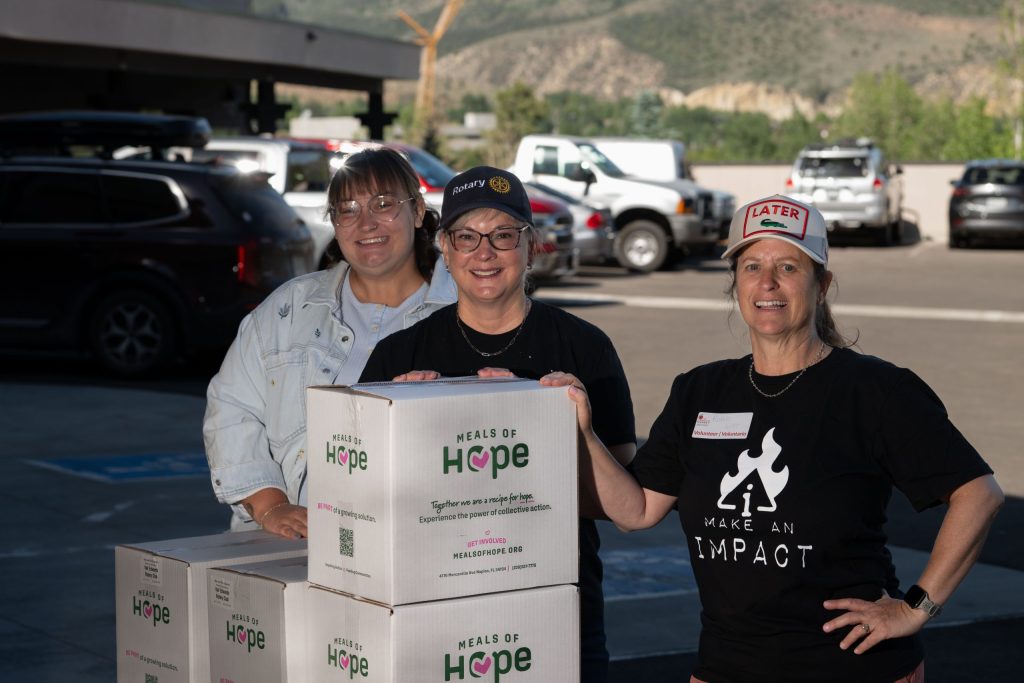
The foundation was serving 1,800 people a week during the pandemic, according to Anshutz. That number climbed to 4,800 in the years following the pandemic.
“And we thought that was a lot,” Anshutz added.
According to her, the foundation currently serves 6,000 people a week through its food pantries alone. The increase has put added pressure on the foundation’s staff and financial position, and rising costs have not helped.
“You can imagine when you are purchasing for that many people a week, the cost is increasing as well,” Anshutz said. “We hear from community members who are in the position to support nonprofits … they have a sentiment of scarcity. There’s a lot of uncertainty.”
Anshutz also noted that the Western Slope residents served by the foundation are disproportionally employed. When the foundation did a household survey, three-quarters of the respondents were employed full-time, and many of the last quarter were fixed income seniors, according to Anshutz.
“People accessing nonprofit and community services, particularly in the food insecurity space, they’re employed, they’re working, they’re contributing to our communities,” Anshutz said.
She added, “I would have given up a long time ago if I was up against what a lot of the families we serve are up against. But they’re not giving up. They want to stay here. They believe in our communities.”
Anshutz said she hopes the legislature addresses affordability concerns during the 2027 session, focusing on affordable housing solutions — including affordable rentals — and on supporting state and federal programs such as the Supplemental Nutrition Assistance Program, also known as SNAP, and the Supplemental Nutrition Assistance Program for Women and Infants. The programs provide monthly grocery funds for low-income families, pregnant women and new parents.
“I think that’s the story that the Legislature needs to hear,” Anshutz said. “We know SNAP, WIC, Medicaid, affordable housing – they have an economic benefit to communities long term. It keeps a working population here. It keeps a rich diversity in our communities. It ensures that our tourism economy works.”











Support Local Journalism
Support Local Journalism
Readers around Steamboat and Routt County make the Steamboat Pilot & Today’s work possible. Your financial contribution supports our efforts to deliver quality, locally relevant journalism.
Now more than ever, your support is critical to help us keep our community informed about the evolving coronavirus pandemic and the impact it is having locally. Every contribution, however large or small, will make a difference.
Each donation will be used exclusively for the development and creation of increased news coverage.