Fewer people are booking Thanksgiving trips to Colorado as many wait for snow
Expensive room rates and later opening dates for ski resorts could be behind lower occupancy at Colorado lodging destinations during Thanksgiving


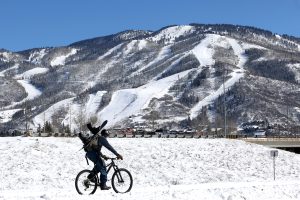
Shelby Reardon/Steamboat Pilot & Today
Thanksgiving bookings to Colorado resorts are looking weaker than last year, as cost-sensitive travelers continue to hunt for bargains and ski resorts open later in the year.
Colorado lodging destinations are seeing drops in year-over-year bookings for the week of Thanksgiving, according to travel data from Inntopia. While the combination of Thanksgiving week’s lower bookings and slightly lower rates means lower revenue for resorts, that’s not necessarily an indicator of how the industry is performing, according to Tom Foley, director of business intelligence for Inntopia.
“(Thanksgiving) is not a really big holiday; it’s more like an ‘attract and get people in the door’ holiday,” Foley said. “Even April right now has higher rates than November.”
Rooms booked in Colorado for the week of Thanksgiving were down slightly from last year as of Oct. 31. The first few days of the holiday break — Sunday, Monday and Tuesday — were seeing the steepest declines, ranging from 6.6% to 7.4% drops in occupancy.
Thanksgiving Day is seeing more moderate declines, with 5.1% fewer rooms booked year over year, despite being the weekday with the highest number of bookings. Absolute occupancy for Thursday, Nov. 26, was sitting at around 44% as of the end of October, meaning 44% of all available rooms were reserved for the holiday.
That occupancy drops noticeably by the following weekend, with roughly 22% of available rooms reserved for the Sunday after Thanksgiving.

Revenue for the holiday break is also down moderately compared to last year, with a dip of approximately 7% for the period of Nov. 19 through Dec. 1, as of the end of October. Foley said the lack of a big price spike in room rates during Thanksgiving compared to other holidays is mostly responsible for the decrease, which closely matches industry trends for the rest of the winter season.
November’s average daily rate for Colorado resorts currently sits right around $266 per night. In December, that jumps up to $750.
Although a more active Thanksgiving week can sometimes bring a modest boost in revenue for lodging destinations, Foley said weaker bookings during the holiday don’t typically have as big of an impact as other major travel seasons.
As opposed to other holidays and school breaks — such as spring break — the popular option for many families celebrating Thanksgiving is often traveling home and lodging with family members, rather than booking a hotel.
“In Colorado last year, Thanksgiving Day had an occupancy level shy of 60%. That’s well below where you would expect things to be when you compare that to the middle of the Christmas holidays, (which) tend to come in very close to 90% occupancy,” Foley said. “It’s a very different animal.”
Additionally, Colorado’s higher price per room compared to other destinations in the mountain west might be a damper for price-sensitive travelers — especially when several ski resorts won’t be open in time for Thanksgiving.
According to data from Inntopia, the average price of a hotel room in Colorado during the winter is between $100 and $150 higher per night than the price of rooms in neighboring states. Poor memories of last year’s snow and delayed openings for some ski resorts could be further weakening the incentive for a Thanksgiving trip to Colorado’s mountains, Foley said.
“Colorado consumers, along with their Utah compatriots, are a little bit more gun-shy this year, just based on their snow experience last year,” Foley said. “Opening days tend to come just before Thanksgiving weekend or maybe a little bit after, and we’re seeing a few opening days get pushed back a little bit. That might be contributing as well.”
Steamboat Ski Resort was one of the resorts to postpone its Opening Day this year, announcing on Nov. 17 that it would be pushing access to its trails from Saturday, Nov. 21, to the Friday after Thanksgiving day. Wolf Creek Ski Area, which had already opened in October, was closed shortly after due to severe regional flooding.
“(Thanksgiving) tends to act as a bit of a trigger mechanism for the beginning of the winter season,” Foley said. “There’s a certain panache to opening day that does draw people out. They want to go to Opening Day, and so if that’s going to get punted, I think that would be a reason for people to not go.”
Several ski resorts across Colorado began spinning lifts during the first half of November —including Arapahoe Basin, Breckenridge, Copper Mountain, Keystone, Loveland and Vail Mountain — though many are operating with limited terrain as snowmaking operations continue.
Wolf Creek Ski Area is scheduled to reopen on Saturday, Nov. 21, with resorts like Beaver Creek, Crested Butte and Granby Ranch following closely behind on Nov. 25. Aspen Mountain and Snowmass Ski Resort are both scheduled to open on Thanksgiving Day.








Support Local Journalism
Support Local Journalism
Readers around Steamboat and Routt County make the Steamboat Pilot & Today’s work possible. Your financial contribution supports our efforts to deliver quality, locally relevant journalism.
Now more than ever, your support is critical to help us keep our community informed about the evolving coronavirus pandemic and the impact it is having locally. Every contribution, however large or small, will make a difference.
Each donation will be used exclusively for the development and creation of increased news coverage.