Planned horse gather in Sand Wash Basin aims to reduce herd size by more than 245 horses in 2026
Use of helicopters raises questions

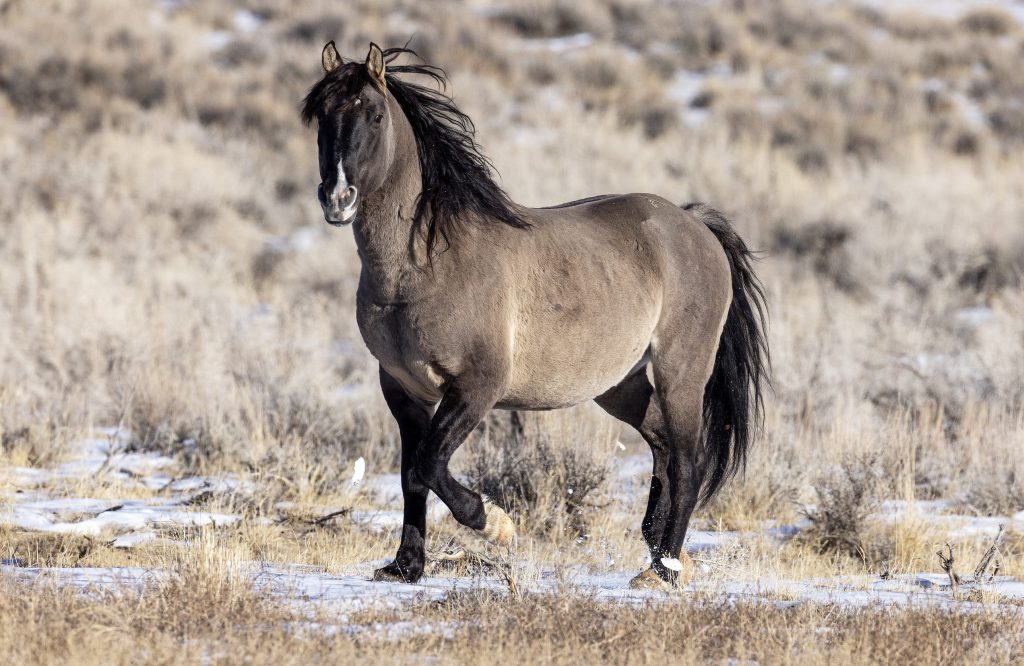
John F. Russell/Steamboat Pilot & Today
The U.S. Bureau of Land Management’s decision to move from a planned wild horse bait-trap operation to a helicopter capture operation in the Sand Wash Basin will allow the agency to efficiently reach the appropriate level of wild horses in the area, according to officials.
“Colorado has been identified as a priority to bring the wild horse population within appropriate management levels statewide, including removal of excess horses that have moved outside herd management area boundaries,” said Steven Hall, U.S. Department of Interior spokesperson.
“To achieve appropriate management levels within Sand Wash Basin, bait-trapping would require removing 100 wild horses annually for the next three years, resulting in more horses removed during more gathers, and would not allow removal of wild horses that have moved outside of herd management area boundaries,” added Hall.
Hall said the current estimated population within and outside the Sand Wash Basin Herd Management Area is 507 wild horses — well above the bureau’s ideal management level of between 163-362 horses. The number includes horses that have migrated outside the management area and trespassed on private property in search of water and forage.
Hall contends that drive-traps — where a helicopter drives horses into a long corridor that funnels the animals into a trap — is a safe and humane method for gathering wild horses. He added that drive-trap gathers are more efficient for gathering large numbers of horses, and allows the BLM to reach outside the boundaries of a herd management area.
Back in March, the BLM announced that a bait-trap operation would take place in the Sand Wash Herd Management Area in an effort to reduce the herd by 100 horses, luring them into traps with food or water. The BLM also planned other efforts in the Piceance herd management areas to gather in the neighborhood of 1,000 horses.
In the two months since the announcement, the BLM has decided that a drive-trap operation would also be used to gather more than 245 horses in Sand Wash Basin. Hall said the idea is to bring the current population to 261. When combined with darting, the effort would limit the need for future gathers. Hall also contended that this will make darting — where CO2-powered rifles are used to inject a dart filled with fertility control vaccines into the rump of the horse — more effective.
“Darting is effective in reducing the frequency of gathers. Darting has been effective in Little Book Cliffs, Spring Creek and Sand Wash in reducing the size and frequency of gathers over time thanks to help from BLM partners and friend groups,” Hall said. “Achieving appropriate management levels in Sand Wash will help increase the efficacy of fertility control treatments by reducing the number of animals that require treatment annually.”
News that the bureau was shifting from bait-trap operations to a drive-trap caught horse advocacy groups off guard, including photographer Scott Wilson who leads PhotoAdvocacy. The group uses wildlife and landscape photography to drive conservation and give a voice to animals — including wild horses.
“I was surprised,” Wilson said of the plans. “It seems like an unwarranted escalation of things. We’re basically going from 100 horses being removed, which was already distressing, to 250, which is quite a leap. Bringing in helicopters, which obviously adds to the sort of total distress of the herd, is an unnecessary expense in a difficult time for budgets and for horses.”
When asked about the cost of the gathers, Hall said he did not have that information. However, he added that he should be able to provide the information closer to the gathers, which will take place in Piceance-West Douglas, Piceance-East Douglas and North Piceance from Aug. 1-30, and in the Sand Wash Basin Herd Management Area from Sept. 10-30.
Wilson said there are more than 60,000 horses being held off-range by the BLM at a lifetime cost of $48,000 per horse. Wilson added that since 1971 the range that was home to wild horses has shrunk from 800,000 acres to 400,000 acres.
While Wilson and Hall disagree about methods used for this year’s gather operations, the two share an understanding of the importance of darting to control the number of births in herd management areas.
“I think fertility control is the best tool in the toolbox,” Wilson said. “My vision is no different from the people who are sitting around the table at the Colorado Wild Horse Working Group that set out this plan to expand fertility control and manage populations humanely without the need for helicopters.”
The Colorado Wild Horse Working Group is a 23-member state task force that includes a BLM representative who partners with advocacy groups to manage herds. Wilson said, with time, that the group could achieve the goal of vaccinating 70%-80% of the mares with fertility control vaccines to effectively control herd populations.
“It’s been frustrating. We have this very earnest state-based collaboration where the right people, from sort of all sides of the wild horse debate, are around the table. They’ve come up with a plan and an objective to raise the level of darting of females to that level we need to stabilize populations,” Wilson said. “So trying to outrun that process with helicopters just seems illogical, it doesn’t make financial sense, and it’s certainly not favoring the horses.”
John F. Russell is the business reporter at the Steamboat Pilot & Today. To reach him, call 970-871-4209, email jrussell@SteamboatPilot.com or follow him on Twitter @Framp1966.

Support Local Journalism
Support Local Journalism
Readers around Steamboat and Routt County make the Steamboat Pilot & Today’s work possible. Your financial contribution supports our efforts to deliver quality, locally relevant journalism.
Now more than ever, your support is critical to help us keep our community informed about the evolving coronavirus pandemic and the impact it is having locally. Every contribution, however large or small, will make a difference.
Each donation will be used exclusively for the development and creation of increased news coverage.