Here’s how the 2023-24 ski season compared to past years, according to meteorologists
Data points to a fairly average season with a somewhat strong finish
Summit Daily

John F. Russell/Steamboat Pilot & Today
Another ski season is nearing its end in the Colorado High Country. For meteorologists, “average” is the word that comes to mind when they think about this winter and spring compared to others.
“My parting thought about this season was that I was happy with ‘average,'” wrote OpenSnow.com founding meteorologist Joel Gratz in a May 1 blog post.
“Sure, we can always hope for more snow, but an ‘average’ season is still pretty good and offers plenty of opportunities for powder days, sunny skies, and everything in between,” Gratz continued.
For about half the season, from November through mid-January, snowpack levels throughout the state were significantly below the 30-year-median, according to data from the Natural Resources Conservation Service. Then, in mid-January, snowpack began to surge, straddling the 30-year median. For a month between March 14 and April 14, levels were above the normal threshold.
Specific basins saw greater snowpack than what was reported statewide, such as the Colorado River Headwaters Basin that encompasses a slew of high-profile ski areas including Breckenridge Ski Resort, Copper Mountain Resort, Vail Mountain and Beaver Creek.
The Colorado River basin’s snowpack levels held consistently above the 30-year median beginning on March 4 — 10 days before the trend was seen statewide — and through mid-April, though levels had briefly pushed above normal a few times earlier in the season.
In Summit County, for example, that meant above-average snow accumulation for some areas. In Dillon, a SNOTEL site recorded 134.5 inches of total snow accumulation between September and April, according to National Weather Service meteorologist Bernie Meier.
The seasonal average for that site is 108.4 inches. During the 2022-23 season, the site recorded 105 inches for the total season, which ends in June, while in 2021-22 it recorded 111 inches, Meier said.
Another SNOTEL site in Breckenridge recorded 144.7 between September and March and has not yet reported its April figures. But it puts the site at just below normal for snow accumulation through March, with average accumulation for that time being 146 inches.
Looking at the Colorado River basin as a whole, “The seasonal precipitation came in at 101%, so almost as normal as you can get,” Meier added.
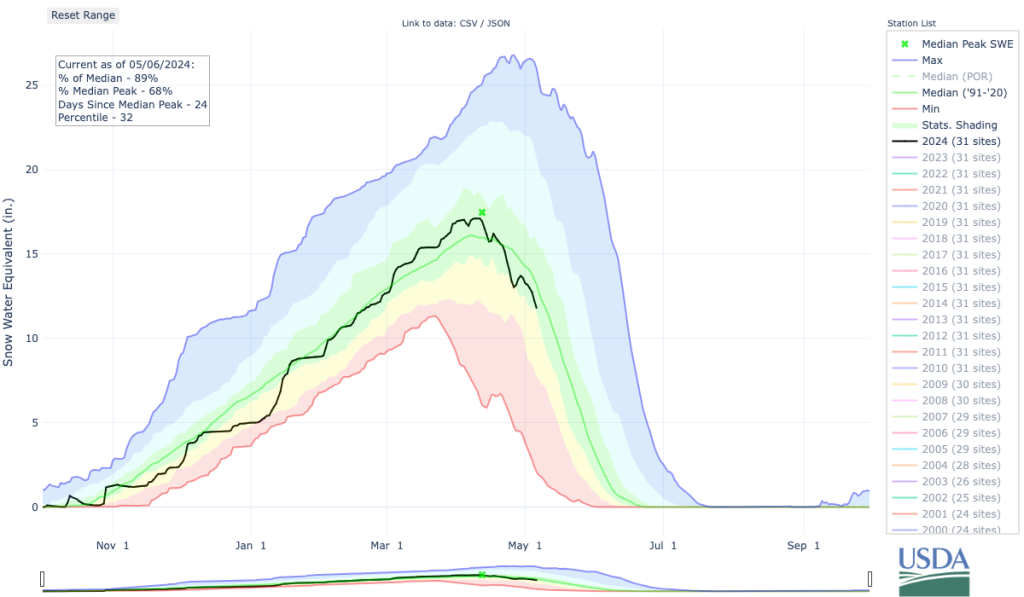
Natural Resources Conservation Service/Courtesy illustration
Zooming in on a ski area like Copper Mountain, snow base depth remained strong for much of the season, according to OpenSnow meteorologist Sam Collentine.
In a May 1 blog post, Collentine stated that a review of Copper data showed that the resort was 69% below the 30-year normal snow depth in November and 17% below in December but was 32% above in January, 9% above in February, 30% above in March and 34% above in April.
“According to our monthly snowfall chart for Copper Mountain, we recorded 14 powder days with 6 inches or more from December through April,” Collentine wrote.
The healthy snowpack, boosted by several spring storms, helped Copper extend its closing date to May 12 — marking the second time in two years that the resort has remained open into May.
Other resorts that extended seasons included Steamboat Resort, which extended its ski activities by a week from its original end date, closing on April 21. Last season, the resort closed on April 16. Prior to then, Steamboat had not extended its season by a week or more since 1993.
Others, like Breckenridge and Arapahoe Basin Ski Area, have yet to announce a closing date. Last season, Breckenridge closed on May 21 while Arapahoe Basin closed on June 4.
In his 2023-24 season preview published in August, Collentine predicted that with the switch to an El Nino pattern, Colorado would see average snowfall with the potential for a stronger start and end to the season.
“This winter forecast preview tended to be right on the mark with a snowpack hovering right around the 30-year normal by the time we reached the peak snowpack in late April,” Collentine wrote in a May 1 blog post on OpenSnow.com.
El Nino refers to the warming of surface temperatures of the Pacific Ocean off the coast of South America and the subsequent change in the jet stream that can occur. Typically, this translates to less snow and dryer conditions in the northern U.S. with more snow and wetter conditions in the southern U.S.
The pattern, however, has little correlation on conditions in the country’s central regions, including much of Colorado, making it hard to discern El Nino’s effects on the High Country.
Heading into the summer, experts predict El Nino will give way to a La Nina pattern, representing the inverse wherein the jet stream brings wetter, cooler temperatures to the north and warmer, dryer temperatures to the south.
La Nina is likely to persist into the fall and winter as well, with an “80-90% chance for a La Nina during the winter of 2024-2025,” Gratz stated in his May 1 post.
Gratz added that while he has “low to no confidence” in predicting snowfall so far out, La Nina tends to be the opposite of this season’s El Nino, meaning next season “could bring average to above-average snow to Canada and the northern Rockies and possibly below-average snow to the southwestern U.S.”
But once again, Colorado falls in-between both zones, “so anything could happen,” Gratz stated.





Support Local Journalism
Support Local Journalism
Readers around Steamboat and Routt County make the Steamboat Pilot & Today’s work possible. Your financial contribution supports our efforts to deliver quality, locally relevant journalism.
Now more than ever, your support is critical to help us keep our community informed about the evolving coronavirus pandemic and the impact it is having locally. Every contribution, however large or small, will make a difference.
Each donation will be used exclusively for the development and creation of increased news coverage.