Colorado streamflows projected to be a quarter of normal this summer
A ‘volatile’ winter pushed up river peaks, but now streamflows are dropping

John Chalstrom/Craig Daily Press
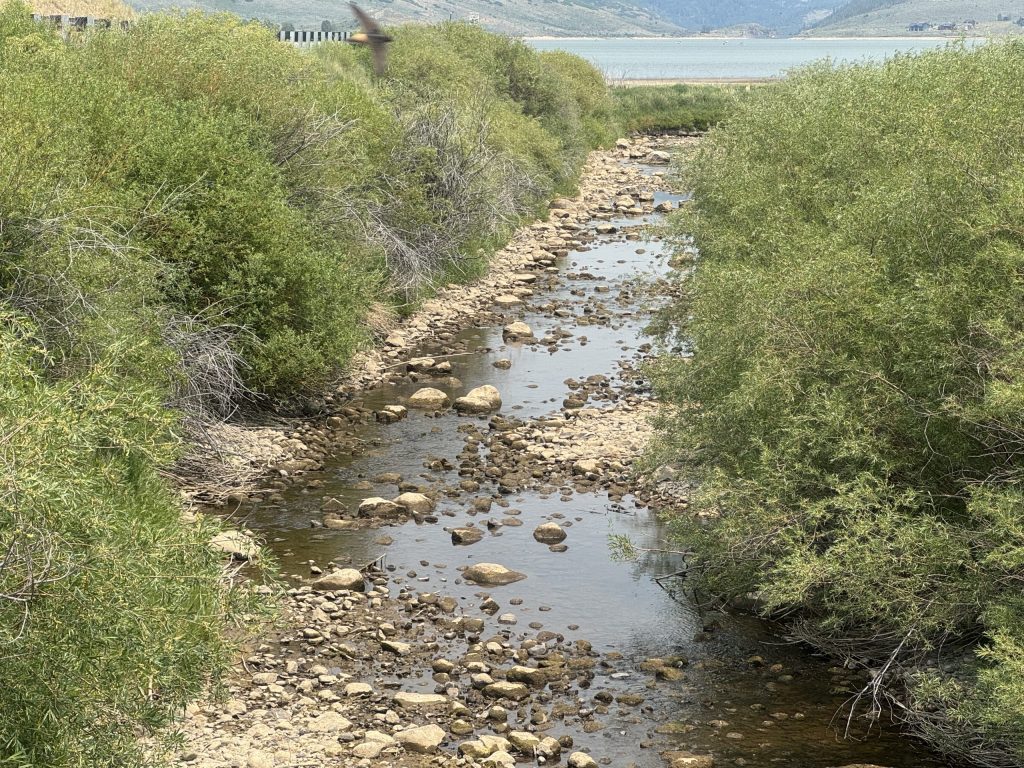
Colorado’s rivers and streams are expected to flow at only a quarter of normal levels during June and July, following what the Natural Resources Conservation Service referred to as an “unusual volatile winter” in its June water supply outlook.
On the Western Slope, the outlook is even more grim, with the Colorado River headwaters basin expected to see streamflows 21% of normal and the Yampa-White-Little Snake basin 19% of normal during these two months.
This year, Colorado’s snowpack accumulation was the lowest on record, affirmed Nagam Bell, a hydrologist for the Natural Resources Conservation Service in the state, at the June 16 Colorado Water Conservation Board’s water conditions monitoring meeting.
In March, a heat wave spurred an early meltoff of the snowpack, causing streamflows to rise ahead of schedule. Bell reported that March streamflow was 140% of normal, “typically because we don’t have runoff that early.”
While this depleted nearly half of the snowpack, the Natural Resources Conservation Service reported that cooler conditions and late-season snowfall “hastened the decline throughout April.” In mid-May, Colorado’s streams saw a second rise and peak that’s not uncommon to see that time of year, Bell said. The May peak, however, is normally the first — not the last — of the season.
“In some rivers the May peak became the seasonal maximum,” according to the Natural Resources Conservation Service June supply outlook. Typically, Colorado streamflow peaks in early June.
Statewide, observed streamflows from March through May were 50% of normal, Bell reported. April and May alone saw streamflows at 41% of normal due to the March runoff skewing the agency’s seasonal comparison.
Meltoff this year was 36 days ahead of schedule, Bell said.
By June 1, owing to this early and accelerated melt, the Natural Resources Conservation Service reported that 91% of its SNOTEL stations were fully melted out — compared to the normal 56% for that date. Within the Colorado River headwaters, only 3% of normal snowpack for this date remained. The Yampa, White and Little Snake basin was the highest in the state, sitting at 30% of normal on June 1.
“This is the third-lowest June snowpack in the NRCS Snow Survey period of record, surpassed only by 2002 and 2012 — years which both contained a higher seasonal (snow-water equivalent) peak in mid-March but experienced rapid meltout in early April and May,” the June outlook reported.
Statewide snowpack was 100% melted by June 10.
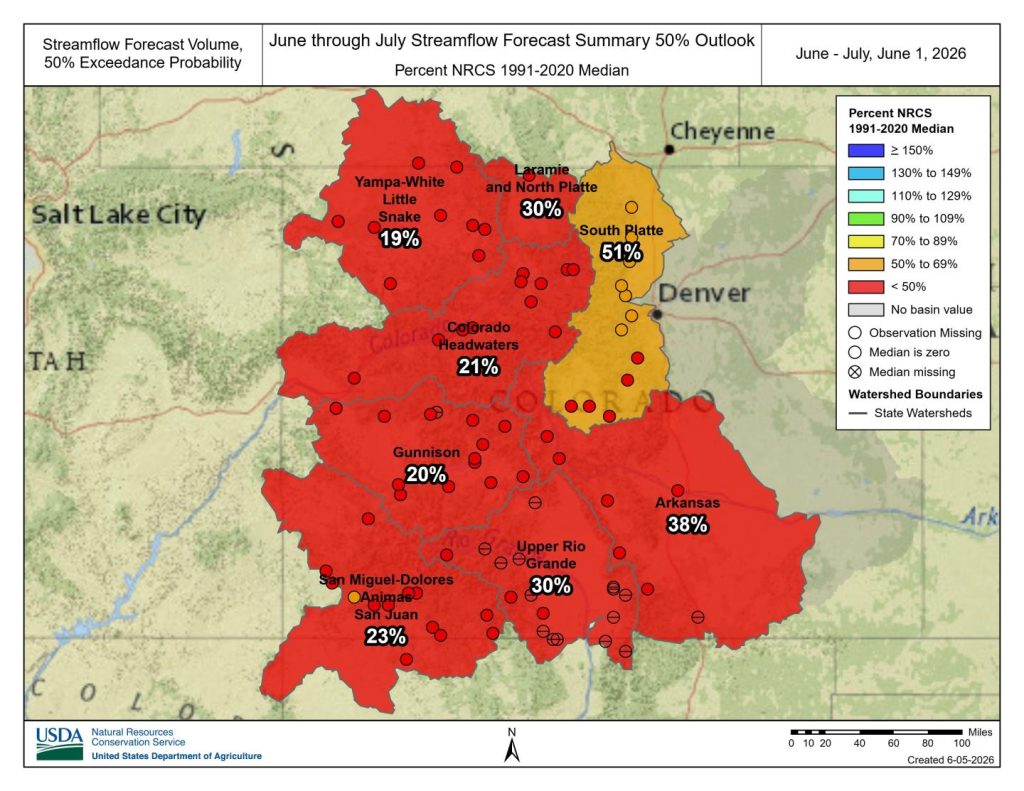
The statewide streamflow forecasts now show that June and July will see flows at 24% of normal.
Within the Colorado River basin, the forecasts go as low as 16% of normal along Muddy Creek below Wolford Mountain Reservoir near Kremmling. The highest forecast is at Willow Creek below the Willow Creek Reservoir near Granby, which is projected to see 36% of normal for the two months.
The Yampa, White and Little Snake basin is projected at a slightly lower range, from 11% of normal at the Little Snake River near Dixon to 30% of normal on the North Platte River near Northgate.
As the dismal snowpack begets low streamflows, some of Colorado’s reservoirs are beginning to see impacts.
Bell said that while statewide reservoir storage was 75% of normal — down from 85% of normal in May — this was largely due to the significant precipitation events in the state’s southern basins in October as well as existing storage.
“We started the water year out (in October) at 103% (of normal), so that carryover has definitely been helpful,” she added.
As of June 1, the Natural Resources Conservation Service reported that Colorado was utilizing 54% of total reservoir capacity compared to 61% at the same time last year. In some basins — including five on the Western Slope — the reservoir storage fell below the normal for the past 30 years.
Across the Colorado River headwaters, storage was at 80% of normal compared to 101% at the start of June 2025. Storage in the basin ranged from Vega Reservoir near Collbran, which sat at 46% of normal on June 1, to Shadow Mountain Reservoir near Granby, which was 97.5% of normal.
In the Yampa, White, Little Snake basin, storage for its four reservoirs was 78% of normal, down from 96% of normal at the start of June 2025. High Savery Reservoir in Wyoming was the lowest as of June 1, sitting at 49.4% of normal. Elkhead Reservoir near Craig was at 100% of normal.
With June marking the ninth month of the water year that will be memorialized for its record-low snowpack and streamflows as well as its extreme, record-setting heat, drought conditions persist in 100% of the state, according to the June 16 U.S. Drought Monitor. As Colorado’s climate experts and forecasters look for any bright spot or relief for the drought, many are looking at the June 11 arrival of El Nino at the expected arrival of a Super El Nino by the end of the year.
Still, when asked at the June water conditions meeting whether El Nino — dictated by a rise in sea surface temperatures — will guarantee improvements, Colorado State Climatologist Russ Schumacher was cautious in his response.
“The signal for El Nino is quite strong to our south; the southern tier of states tend to be cooler and wetter than average during falls and winters in El Nino, and the opposite for the northern tier of states and up into Canada. We sit right in the middle, so it’s always more of a wild card here in Colorado than it is in other places,” Schumacher said. “There’s never any guarantees with this, but I think at least it tilts the odds in a better direction than what we’ve had over the last year or so.”





Support Local Journalism
Support Local Journalism
Readers around Steamboat and Routt County make the Steamboat Pilot & Today’s work possible. Your financial contribution supports our efforts to deliver quality, locally relevant journalism.
Now more than ever, your support is critical to help us keep our community informed about the evolving coronavirus pandemic and the impact it is having locally. Every contribution, however large or small, will make a difference.
Each donation will be used exclusively for the development and creation of increased news coverage.