Western Colorado lawmakers hope new law can connect housing and transit in mountain towns
House Bill 1065 unlocks new financing tools for communities that want to build housing along transit corridors, such as the planned mountain rail passenger line

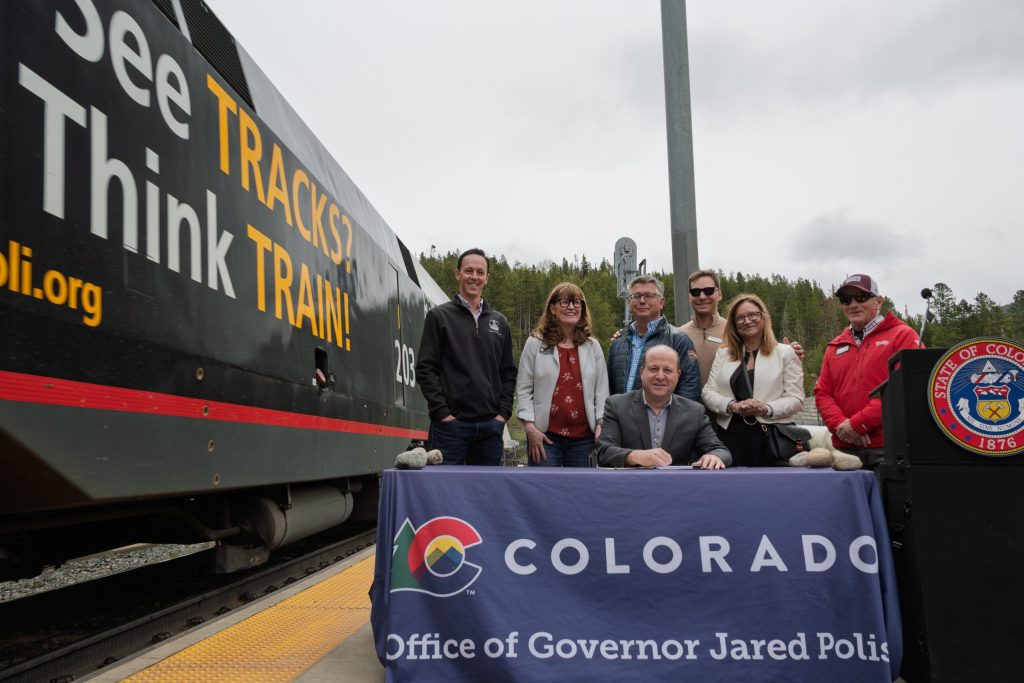
Colorado Gov. Jared Polis’ office/Courtesy photo
An Amtrak train zipped along the edges of Winter Park Ski Resort on a cloudy day in Colorado’s High Country, as Gov. Jared Polis and state lawmakers — huddled mere feet from the tracks — hailed a new law to incentivize more housing and transit development.
House Bill 1065, which Polis signed Wednesday, May 27, unlocks state financing for communities that want to build below-market-rate housing near rail lines, bus stations and other transit hubs.
“Transportation and housing go hand-in-hand,” Polis said in a statement issued shortly after the bill signing. “Unleashing amazing livable and workable spaces for people to thrive is what Colorado is all about.”
Western Slope lawmakers who helped spearhead the bill hope it will spur investment in transit corridors such as the planned mountain rail passenger line. The project, which expands the existing Denver to Winter Park line, is on track to deliver daily, year-round service between Denver and Granby by the end of 2026. Future stops are planned for Steamboat Springs, Hayden and Craig.
Lawmakers hailed the new financing law in a news release.
“This new financing tool creates a pathway for local governments to boost funding for multimodal transit systems and housing that Coloradans can afford so we can better meet the needs of our communities, especially in the High Country,” said Colorado House Speaker Julie McCluskie, D-Dillon. “I am excited to deliver affordable, transit-oriented housing across the state.”
Under the bill, local governments will be able to use state sales tax dollars to fund transit-related infrastructure in designated areas. Those dollars will then be repaid using tax revenue from those areas, which generate more economic activity, through a process known as tax increment financing.
Local governments could be eligible for up to $75 million per year in state sales tax revenue. Since the measure is considered a pilot program, the funding will be for six total projects over three years.
The bill also creates a new state tax credit to help communities build housing in those transit areas, with the state allocating up to $50 million per year in credits starting in 2027 through 2033. Total tax credit funding could top $350 million over 12 years.
State Sen. Dylan Roberts, D-Frisco, another of the bill’s sponsors, said that the mountain communities he represents have some of the “most severe housing shortage and cost crises in the state.”
“So I’m proud to sponsor this legislation that will help finance and build homes that working families need and can afford,” said Roberts, whose district includes Vail, Breckenridge, Steamboat Springs and the Fraser Valley.
Other bill sponsors were Rep. Steven Woodrow, D-Denver, and Sen. Tony Exum, D-Colorado Springs. The measure was among a package of housing bills passed this year by the legislature and signed into law by Polis.
That includes Senate Bill 1, also sponsored by Roberts, which loosens restrictions on how local governments fund affordable housing, and House Bill 1001, which allows schools, colleges and nonprofits to bypass some local zoning rules to build affordable housing on property they own.
Another housing bill, Senate Bill 155, would fund a grant program to help homeowners install hail-resistant roofs in a bid to lower property insurance. The program would be funded with a fee on insurance carriers and is awaiting Polis’ signature.
The bill was a high priority for McCluskie, who tried and failed to pass similar legislation last year, and for Polis, who has made lowering homeowners insurance costs a key part of his affordable housing agenda.






Support Local Journalism
Support Local Journalism
Readers around Steamboat and Routt County make the Steamboat Pilot & Today’s work possible. Your financial contribution supports our efforts to deliver quality, locally relevant journalism.
Now more than ever, your support is critical to help us keep our community informed about the evolving coronavirus pandemic and the impact it is having locally. Every contribution, however large or small, will make a difference.
Each donation will be used exclusively for the development and creation of increased news coverage.