Steamboat Springs police chief defends use of Flock cameras
Beckett cites crime-solving benefits; residents at public forum question privacy risks, data sharing, potential misuse


Sydney Anderson/Steamboat Pilot & Today
In a public forum packed with 80-plus people Tuesday night, Steamboat Springs Police Chief Mark Beckett defended Flock camera technology and underscored its benefits — while also acknowledging a wide range of concerns and objections voiced by community members.
The two-hour session in Steamboat’s Centennial Hall, facilitated by former City Council President Jason Lacy and attended by another 70 people via Zoom, was announced in late July as discussions on the use and potential abuse of Flock cameras have escalated over the last few months both locally and nationally, at times to the point of vandalism.
On a table at the back of the room were three hard-copy documents — the Steamboat Springs Police Department policy manual on automated license plate readers, a handout from Flock on proving data deletion, and another handout from Flock on “myths and facts” of its technology.
Also in attendance were Hayden Police Chief Scott Scurlock, Routt County Sheriff Doug Scherar and several Steamboat Springs City Council members.
Beckett and Police Operations Commander Greg Griffin, who the chief called the department’s “Flock expert,” opened the forum with an overview on automated license plate readers: how they work, why they’re useful for solving crimes, and how and when certain data is shared with other law enforcement agencies.
“A year ago, I understood in broad strokes this technology,” said Beckett. “Today, I understand it very well … and we understand how polarizing this topic has become.”
Beckett said that Steamboat Springs has six automated license plate readers within city limits: Shield Drive and U.S. Highway 40 eastbound; the 1200/1300 block of Lincoln Avenue, both eastbound and westbound; U.S. 40 between Pine Grove Road and Mount Werner Road, both eastbound and westbound; and U.S. 40 westbound on the off-ramp onto Mount Werner Road North.
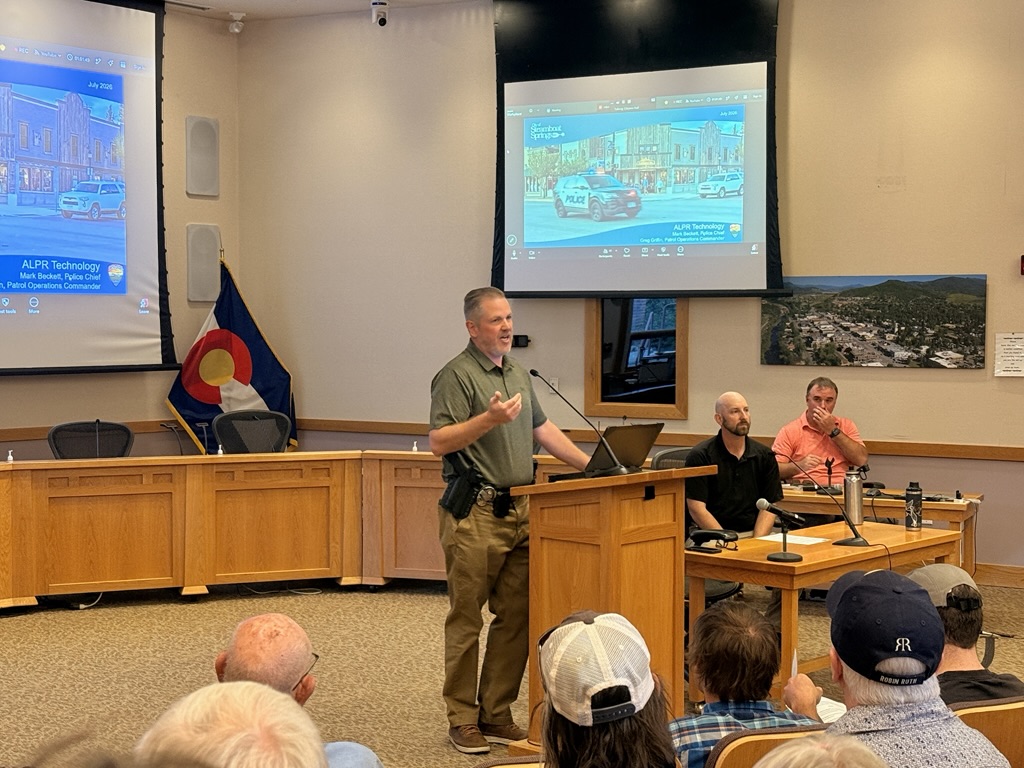
Griffin explained that automated license plate readers passively log every license plate that passes in front of the camera so that the information is available in a search for a certain period of time.
The cameras then run those plates against databases Griffin said are accessible only to “sworn law enforcement personnel.” He said those databases are the Colorado Crime Information Center, the National Crime Information Center and the National Center for Missing and Exploited Children.
Through Flock data-sharing, officers are alerted to potential crimes involving gang activity or suspected terrorists; missing persons; stolen vehicles; violent persons; felony warrants; carjacking; or a missing child.
The information collected through Flock cameras is stored for 30 days before it is “completely wiped,” said Griffin, who added that once it is deleted, it cannot be recovered.
Steamboat Springs Police Department’s standard operating procedure, he explained, is to keep the data for 72 hours. Should an officer want to extend that to seven days, that officer would require approval from Griffin. An extension beyond seven days — up to 30 days — would necessitate approval through Beckett.
Griffin added later that in circumstances in which that information becomes evidence in a criminal investigation, the information is kept in the SSPD evidence retention system, but not in Flock’s.
According to Griffin, automated license plate readers are not a new technology. They were first invented in 1976 in the United Kingdom, five years before U.K. police made their first arrest using the cameras. In the decades since, he said, it has been “vastly” used, particularly for traffic law enforcement.
“Law enforcement and government … they have to stay on top of technology,” said Beckett. “It is evolving exponentially every day in a manner that we can’t keep up with if we’re not constantly looking at it.”
“The hazards of not doing that are that we fall behind on governance, we fall behind on policy, and it puts us in a bad space,” he added.
Griffin said Flock officials cannot access data collected by SSPD without specific permission from the department, which would likely occur only in the case of a technological problem.
Beckett then addressed one of the core tenets of some community members’ unease: misuse of Flock technology and the data it captures.
According to an Aug. 2 report from the Washington Post, 50 police officers have been accused of improperly using access to automated license plate reader networks — in some instances allegedly stalking women — with 46 of those cases involving Flock.
“Those are all misconduct issues,” said Beckett. “If I choose to do something illegal with that, I go to jail, I get fired.”
The auditing software provides officers with a “red flag” if they are running a plate in an abnormal manner, ensuring oversight for the system, he added.
While the Flock database is searchable for officers, it also provides relevant alerts. Griffin said the alerts do not include any “personal identifying information” and that photos captured by the cameras do not typically show clear photos of the driver.
“The advantage of that is we have the cameras, the Routt County Sheriff’s Office has cameras, and (the) Hayden (Police Department) has cameras,” said Griffin. “So it allows us access to a lot more technology that we in Steamboat then don’t have to pay for, which is a big advantage.”
Scherar told the newspaper that Routt County currently operates six cameras through a contract originally signed in 2022.
In the town of Hayden, Scurlock said there are two Flock cameras. When he arrived in 2023, the town had a camera that belonged to the Routt County Sheriff’s Office, but the town took responsibility for it and added a second camera in 2024.
In a follow-up statement to the newspaper, Griffin said the first cameras were installed in Steamboat in October 2022 through a trial period with RCSO. By the end of that trial period, those cameras were not within the SSPD budget. In 2025, the department decided to renew the contract and determined where it wanted to place the cameras going forward.
Each department pays $3,000 per year per camera, meaning both RCSO and SSPD are paying $18,000 per year, and Hayden $6,000 per year, in total for automated license plate readers.
The Flock network that includes the SSPD consists of 91 networks and 65 agencies all within Colorado. None, said Griffin, are federal agencies.
Beckett said the SSPD did not bring up Flock cameras as a specific item to City Council but did include it in their budget.
He said the technology has been instrumental in solving crimes, particularly with drug interdiction, which he said SSPD has seen “significant success” in and is his “favorite use” of the cameras.
“Stolen vehicles … we’ve got a ton of incidents of catching felony warrants that otherwise an officer would either have to stumble upon through a traffic stop or through a contact in town,” said Beckett, who added that officers have also had success in using the cameras to locate suicidal subjects.
A heated Q&A session
One question from a community member seemed to reflect the temperature of the room. He asked who in the room would “like Flock gone,” to which nearly every audience member raised their hand.
“Nobody wants these,” said the man. “You’re our servant. You work for us. We all want cops, but we don’t want this.”
Beckett emphasized his awareness that, ultimately, some members of the public will simply not like the idea of automated license plate readers.
“I will tell you if we continue to not do it, or if we move away from technology, Steamboat Springs will fall further and further behind in these areas, and you will find yourself at some point the haven for criminals,” said Beckett. “Because when you create a community where people can go and get away from the places that are doing something, I think it’s a slippery slope.”
With the limits around data retention and storage in mind, one attendee framed their concerns differently: anyone driving near any of those six cameras on a regular basis is, in a sense, perpetually kept in “the system.”
“I didn’t do anything wrong, so you don’t need my information,” said one participant.
A few commenters implied that while they do not necessarily distrust the SSPD, they fear that Flock, and “companies like it,” are not fully transparent regarding their parameters around data collection and sharing.
“I love that we can trust you,” said an audience member who grew up in Steamboat. “However, the next guy to come along doesn’t have the same attitude, necessarily — the same ethics. We can’t control who’s behind the computer at all times.”
“Without having more transparency, I think the community really has a fear of abuse and a fear of how it’s going to be used,” he continued. “This is an opportunity to be proactive. But it’s hard to be proactive when you’ve already got it in place.”
He referred to Beckett’s earlier “slippery slope” comment, calling it a “logical fallacy” and “fear-based policing.”
“That’s not what we want here,” he said, requesting a “balance” between community trust and technology use.
“At the end of the day, there is technology that exists in our country that far exceeds this,” said Beckett. “The federal government through different means could monitor your phones right now. There’s technology that exists that could theoretically do anything.”
Ultimately, Beckett reiterated that the department is using Flock technology ethically and responsibly, and should local misuse occur — and so far, it hasn’t — officers would be disciplined accordingly.
“I’ve heard the concerns, but I’ve never actually seen an incident that is real,” he said.
Following the close of the Q&A, City Council President Steve Muntean told the audience that council’s next meeting is set for 5 p.m. Tuesday, Sept. 1. He invited community members to attend and continue the discussion.




Support Local Journalism
Support Local Journalism
Readers around Steamboat and Routt County make the Steamboat Pilot & Today’s work possible. Your financial contribution supports our efforts to deliver quality, locally relevant journalism.
Now more than ever, your support is critical to help us keep our community informed about the evolving coronavirus pandemic and the impact it is having locally. Every contribution, however large or small, will make a difference.
Each donation will be used exclusively for the development and creation of increased news coverage.