Small dog performs mighty service for disabled owner
Advocates hope to increase community understanding of service dogs

Suzie Romig Follow
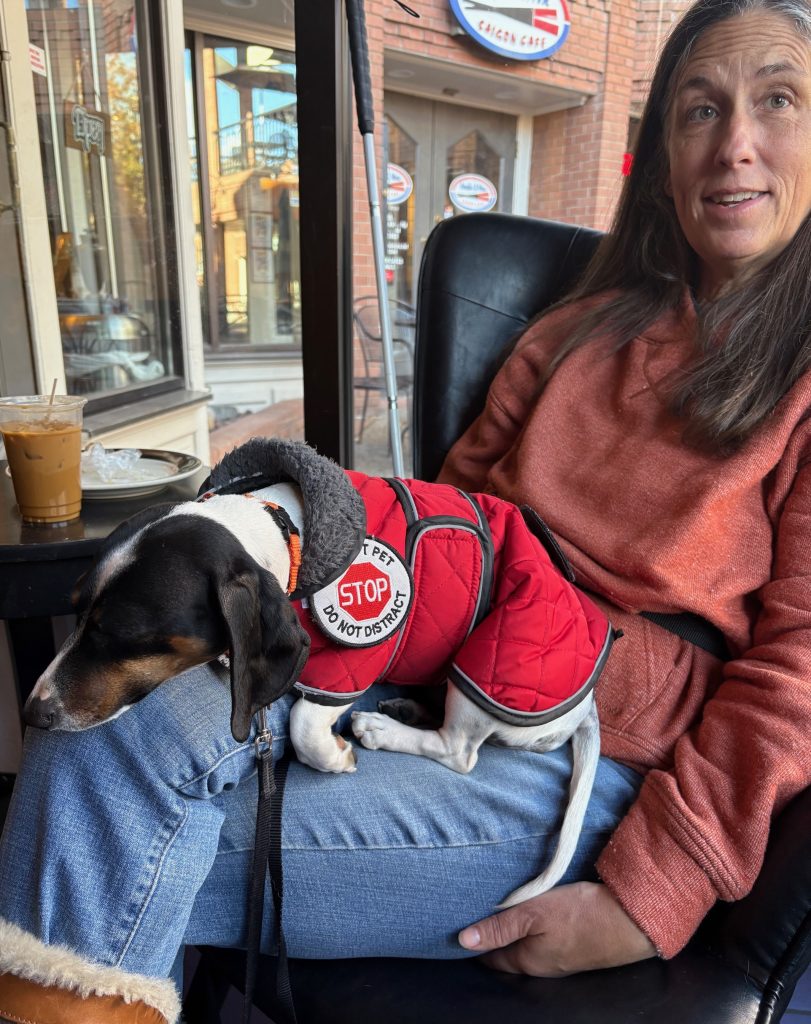
Cindie Hill/Courtesy photo
At 11 pounds, miniature dachshund Missy Jane may be small, but she performs a mighty service for her owner.
Missy Jane has been thoroughly trained to alert her owner, Routt County resident Cindie Hill, before anxiety or PTSD creeps up. Hill said her post-traumatic stress disorder stems from medical trauma and health conditions. So, when Hill taps her feet too much, for example, Missy Jane knows to press against her owner.
The dog owner, with the assistance of a local trainer, taught Missy Jane how to task to sink into “melting mode” in Hill’s lap to provide a deep pressure therapy. Although training a service dog to learn specific tasks to help humans with disability issues takes a lot of work and continued training, Hill said the little dachshund helps her to be able to go out in public.
“When her (service) vest goes on, she has learned it is time to focus, regardless of where we are,” Hill said.
Service dog advocates and nonprofit representatives hope community members and business owners will learn more about the rules related to legitimate service dogs.
Micheal Bertram, co-director at nonprofit Northwest Colorado Center for Independence, said owners of trained service dogs may face barriers due to other untrained dogs acting up. Or non-service dog owners may try to obtain access to public places by saying they need help from an emotional support animal. Bertram calls that misrepresentation “pets in vest.”
“We want to get the bad actors out of the way because they are trying to misrepresent themselves and take advantage of the rules that do not apply to them,” Bertram said. “The harm they cause is they make the community more resistant to people with service dogs who have done it the right way.”

Some people use online resources to have their normal pet declared an emotional support animal or order pet vests with no meaning. Although emotional support animals have their roles, true service dogs are used to help people with medically diagnosed disabilities in public places.
“Service animals — dogs individually trained to perform specific tasks for a person with a disability — are allowed in retail food establishments including indoor dining areas,” explained Scott Cowman, Routt County Environmental Health director. “Emotional support, therapy or comfort animals are not considered service animals under the Americans with Disabilities Act and therefore are not permitted in indoor food areas.”
Cowman noted if a restaurant manager suspects that an animal brought inside is not a service animal, the staff may ask only two specific questions permitted under the ADA: whether the dog is required because of a disability and what tasks it has been trained to perform.
“They cannot request documentation or inquire about the person’s disability,” Cowman said. “If the animal is disruptive, uncontrolled or not housebroken, the business may ask that it be removed but must still provide service to the individual without the animal.”
The county director explained that normal “pet dogs may be allowed in outdoor dining areas only if the establishment chooses to permit them and follows required sanitary and separation criteria established by state and local health regulations.”
Federal and Colorado law do not require a service dog to gain a certification. The Colorado law “Intentional Misrepresentation Assistance Animal” outlines protections, regulations and fines.
A service animal is defined by federal and Colorado law as a dog, or miniature horse, that has been individually trained to perform a specific task or service for a person with a disability, according to nonprofit Disability Law Colorado. A service animal is considered an extension of a person with a disability and is allowed in any place that is open to the public. A service dog can only be excluded from a business or public place if it is out of control or not housebroken.
On the other hand, companion, assistance or emotional support animals “help a person with a disability alleviate one or more symptoms of their disability while in their home,” according to Disability Law Colorado. An assistance dog that helps a person in at home might bark when the doorbell rings to alert someone with a hearing impairment, or a cat can provide a person with bipolar disorder a reason to get up in the morning. Business owners and public places are not required to allow emotional support animals inside.
Under the Air Carrier Access Act, a service animal means a dog, regardless of breed or type, that is individually trained to perform tasks for the benefit of a qualified individual with a physical, sensory, psychiatric, intellectual or other mental disability. Service animals in training, animal species other than dogs and emotional support, comfort or companionship animals are not considered service animals under the transportation act.

Hill said although Missy Jane “leads an amazing dog life,” she also serves in a valuable capacity similar to necessary medical equipment.
“We don’t need to make it hard for people who truly need a service animal to be able to live normally and access places normally,” Hill noted. “I hope that we see more and more service dogs out working, tasking and helping because that means these people are living their lives to the fullest.”
Northwest Colorado Center for Independence, NWCCI.org – serves people with permanent disabilities
Disability Law Colorado – DisabilityLawco.org/issues/category/service-assistance-animals, includes a know-your-rights resource guide
Domino Service Dogs – DominoServiceDogs.com, a nonprofit in Lakewood provides a two-year owner-trained program to assist people with disabilities who are training their own service dog
Doggyu.com – an inclusive community for service dog handlers
ADA.gov – Ada.gov/topics/service-animals






Support Local Journalism
Support Local Journalism
Readers around Steamboat and Routt County make the Steamboat Pilot & Today’s work possible. Your financial contribution supports our efforts to deliver quality, locally relevant journalism.
Now more than ever, your support is critical to help us keep our community informed about the evolving coronavirus pandemic and the impact it is having locally. Every contribution, however large or small, will make a difference.
Each donation will be used exclusively for the development and creation of increased news coverage.