Moffat County admits contact regarding data centers near Trapper Mine
County officials deny presence of non-disclosure agreement or site application
John Camponeschi/Craig Daily Press
Editor’s note: This is a developing story and will be updated as more information becomes available.
During an interview with Craig Daily Press reporter John Camponeschi on Thursday, Club 20 Executive Director Wade Haerle suggested that Moffat County officials had preliminary contact involving potential data center development.
As a result of that report, Moffat County confirmed hours later through a press release that it had been contacted by two entities interested in possible data center development in the Trapper area. The county, however, directly disputed Haerle’s statement that local government officials were operating under nondisclosure agreements.
“Moffat County has been contacted by two entities regarding the possibility of data center development in the Trapper area,” the county said in an Aug. 6 press release. “These discussions have been preliminary and exploratory in nature.”
The county emphasized Thursday that no formal application has been submitted and no data center proposal is currently under review.
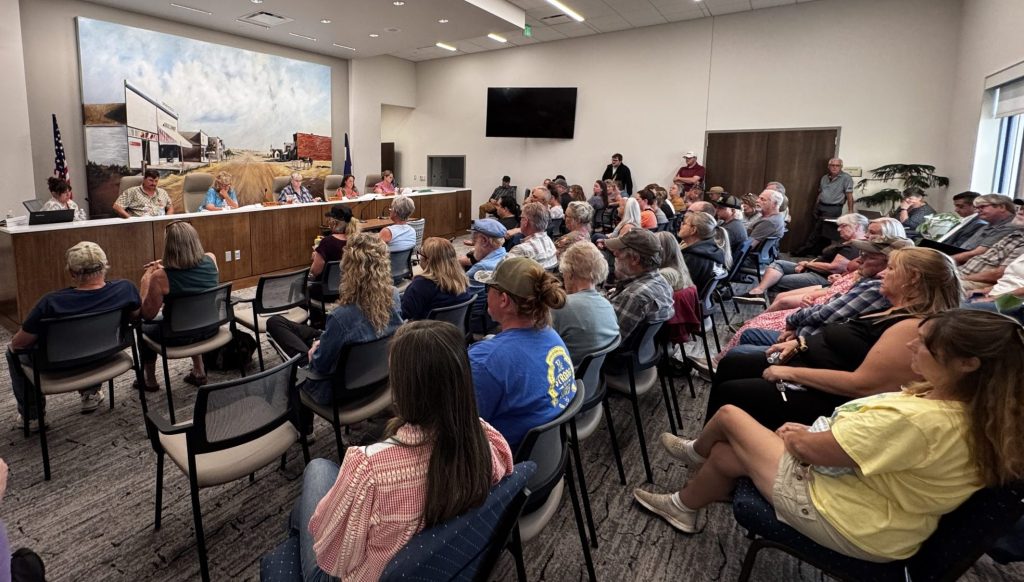
The county’s confirmation establishes that private entities have expressed interest in potential data center development and that those discussions occurred before the Moffat County Planning and Zoning commission began publicly considering changes to zoning regulations Wednesday. It also contradicts statements made by Planning and Zoning Director Candace Miller during the Wednesday meeting.
Comments made by Miller gave the public a broader impression that county officials were preparing for an industry that might approach Moffat County in the future, rather than responding after two entities had already expressed interest.
Miller told the commission she was initiating the review “so that we can be prepared if that were to come our way.”
Later, when a resident asked where the data center zoning initiative came from and who had given officials instructions to begin it, Miller said she had been monitoring developments elsewhere.
“I have been watching what is happening across counties, cities and counties all across the U.S. right now,” Miller said, adding that data centers were a topic likely to come before the county because its regulations did not specifically address them.
When another speaker asked whether the review had been Miller’s idea, she answered, “It was my idea.”
Miller then said the county needed to be prepared “if this comes our way.”
The county’s press release now establishes that the county had already been approached prior to the Wednesday meeting.
Questions remain about what those discussions involved, when they began, which county officials or departments participated and whether the entities made specific requests related to land use, infrastructure or regulatory changes.
Haerle said several companies are examining locations across Western Colorado, particularly communities with coal-fired power plants that have closed or are scheduled to close. Those sites may remain attractive because transmission lines, substations and other electrical infrastructure can remain after a power plant is retired.
When asked which companies had approached Moffat County, Haerle said he did not know their identities.
“All I know is that they have been approached and that the county staff is working on making adjustments to their different plans,” Haerle said. “But there’s a bunch of nondisclosure agreements. There’s notices of intent and letters of intent and those kinds of things that I’m not privy to.”
Asked to clarify whether governments in Moffat County had been approached and were operating under nondisclosure agreements, Haerle responded, “Correct.”
Moffat County challenged that assertion in its press release.
“Moffat County also wishes to clarify that county officials have not entered into non-disclosure agreements related to any potential data center projects,” the release stated. “Statements suggesting otherwise are inaccurate.”
It is unclear whether the “notices of intent and letters of intent” Haerle referenced exist and, if so, which governmental organizations or officials received them.
The Craig Daily Press sought clarification from Club 20 to identify the basis for Haerle’s statement that governments were operating under nondisclosure agreements, and to clarify whether he stands by that characterization following the county’s denial of his prior statement.
In a voice message left for the Craig Press at 5:15 p.m. on Aug. 6, Haerle sought to withdraw his prior statements regarding Moffat County being under a nondisclosure agreement related to data centers, saying his comments were inaccurate.
“I think I misspoke today. I know that there are several governments who have signed NDAs with different folks, and I think I implied that Moffat County had, and I don’t know that to be true or not,” said Haerle in the message.
Haerle went on to say “that is on me, not on you” in reference to the Craig Press reporter who interviewed Haerle via a recorded, on-record conversation. He went on to say that he “screwed up” by confusing Moffat County with another county in reference to his NDA statement.
In the message, Haerle also stated that he had been contacted by Moffat County Natural Resources Director Jeff Comstock regarding Haerle’s statement.
The Craig Press is seeking comment from Moffat County officials about the two entities that contacted it, including when the contacts occurred, which officials participated, whether any written communications or expressions of interest were received and whether the entities requested changes to county plans or regulations.
In its release, the county said officials are routinely contacted by businesses, developers and site-selection representatives considering investments in the area. It attributed the data center interest in part to the marketing of the Trapper Mine site and Tri-State Generation and Transmission Association’s planned closure.
The county said such conversations are a normal part of economic development and should not be interpreted as evidence that a particular project has been proposed, approved or is moving forward.
At the same time, the county is reviewing its zoning and land-use regulations so it is prepared to evaluate a data center proposal if one is submitted. Officials said any future application would proceed through the county’s established public process, including notices, hearings and opportunities for community input.
Haerle said Club 20 does not support or oppose data centers.
The organization is planning a Moffat County community meeting on Aug. 27 to examine potential benefits and concerns, including employment, workforce training, noise, light pollution, wildlife and economic development. The event is being sponsored by Club 20, Moffat County, Colorado Mesa University and the Governor’s Office of Just Transition.
“This is just becoming a fast-moving issue,” Haerle said. “People want to figure out what’s doable, what’s not doable, those kinds of things.”
The county’s statement confirms that two entities have made preliminary contact. It also calls to question why Club 20’s executive director said governments were operating under nondisclosure agreements when Moffat County says no such agreements were signed.




Support Local Journalism
Support Local Journalism
Readers around Steamboat and Routt County make the Steamboat Pilot & Today’s work possible. Your financial contribution supports our efforts to deliver quality, locally relevant journalism.
Now more than ever, your support is critical to help us keep our community informed about the evolving coronavirus pandemic and the impact it is having locally. Every contribution, however large or small, will make a difference.
Each donation will be used exclusively for the development and creation of increased news coverage.