Dementia caregiving: Planning ahead necessary but challenging
First steps: Build knowledgeable medical team, trusted care circle
Special to the Steamboat Pilot & Today
Suzie Romig/Steamboat Pilot & Today
The strongest advice from experts after a dementia diagnosis for a loved one is to plan ahead for the future of caring for someone with a degenerative brain disease.
Yet family members may be so overwhelmed with the difficult diagnosis and day-to-day caregiving struggles of assisting someone with a worsening disease that planning ahead seems like climbing Mount Everest.
“People are generally overwhelmed and in shock when they get the diagnosis,” said Kay Adams, a licensed clinical social worker in Wheat Ridge with 25 years of experience helping and coaching in dementia cases. “Even if people anticipate in advance that they were going to get a dementia diagnosis, when those words are spoken out loud, the oxygen goes out of the room.”
Adams said a tsunami of emotions and concerns hit families post-diagnosis.
“This diagnosis can really feel like an earthquake,” the social worker said. “Everything suddenly looks different, plans change, expectations, roles, routines.”
A 2025 analysis on dementia risks in the U.S. reported the staggering results that from age 55 to 95, the lifetime risk of developing dementia is 42%, according to the Johns Hopkins Bloomberg School of Public Health.
The national nonprofit Alzheimer’s Association notes that 7.4 million people in the U.S. age 65 and older currently are living with Alzheimer’s disease or another form of dementia. That figure is projected to nearly double by 2060. Some 90,800 Coloradans are living with Alzheimer’s, and 1,851 people in Colorado died from Alzheimer’s in 2024.
Alzheimer’s Association, Alz.org/help-support, offers extensive informational tools and resources such as support groups, webinars, 24/7 helpline at 800-272-3900
Vintage Area Agency on Aging, YourVintage.org, financial assistance to family caregivers and resources for people 60 and older
Dementia Caregiver Support Group in Steamboat, 10:30 a.m. second Tuesday of each month at Steamboat Springs Community Center, contact jgweiland@alz.org
Compassion Works, KayMAdams.com, experienced Colorado social worker offers individualized dementia coaching, workshops to families
UCHealth Palliative Care Clinic in Steamboat, nurse practitioner specialty care provides services for long-term chronic conditions including symptom management, emotional support, referrals, 970-875-2647
UCHealth Seniors Clinic at Anschutz Outpatient Pavilion in Aurora, offers geriatric physician services for patients 75 and older, 720-848-3400
Memory Café, monthly at Heart of Steamboat United Methodist Church in Steamboat, presented by Blue Skies Nursing, RSVP requested at Blueskiesnursing.com/event-list
Adams said families often start dementia conversations with their primary doctor, but “a lot of times primary care providers do not feel comfortable or equipped to make a dementia diagnosis for their patients.”
With 120 types of dementia now identified by experts and each patient experience different, Adams’ first suggestion is for family members to take time to educate themselves about dementia. Families can find information through reputable resources such as the Alzheimer’s Association, which advises about all forms of dementia.
Next, families are advised to seek support from medical or social work professionals who specialize in dementia. Nurse Practitioner Heather Hack with UCHealth Palliative Care Clinic in Steamboat Springs reiterated the key first step is to establish a knowledgeable medical care team.
Building the medical care team early and requesting a dementia diagnosis sooner may allow physicians to consider prescribing existing or newer dementia medications that may help stall the patient’s decline, although side effects to the treatments are a concern.
Adams advised that an official dementia diagnosis listed on a patient’s medical record is needed to move forward with many medical, insurance, financial or legal matters.
Source: Compassion Works LLC, Kay Adams
- To understand what is happening.
- Identify potentially treatable causes.
- Access appropriate care and resources.
- Plan while the person living with dementia can still participate.
- Start building a care community.
Before patients with dementia lose decisional capacity, they should work with trusted family members to assign a durable power of attorney designation for both medical and legal/financial matters to a primary designee and backup designees, experts explain.
“Once a person is into moderate severe dementia, they can no longer really make those decisions for themselves, and it’s a real burden to families to then have to make those decisions without knowing what their loved one would want,” Hack said.
Those forms can be downloaded online for free through various reputable legal or medical associations such as UCHealth. The forms are completed when the adult patient is of sound mind and signed voluntarily before a notary public. According to nonprofit Colorado Legal Services, separate forms are required for the two types of power of attorney.
Hack recommended dementia patients consider working with an occupational therapist for cognitive therapy for tips and tricks to bolster memory and to review physical safety measures in a patient’s home environment.
Building a circle of support from family members and friends and then fully communicating necessary information with people in that trusted circle are vital steps to help prevent the common burnout of the primary caregiver. Family members and friends need to be truthfully informed in order to best show support and provide help, Adams said.
“A lot of times people who get diagnosed and their caregivers go underground and don’t tell anybody,” Adams noted.
The experienced social worker recommended the closest key caregivers in the care circle should spend long blocks of time at various times of the day, or several days at a time, with the patient to understand the full scope of the specific dementia struggles.
Many caregivers benefit from joining a dementia caregiver’s support group.
“Just being with other people who are in similar shoes is very, very helpful because the isolation of this disease is really overwhelming,” Adams said.
The social worker noted that friends may not understand how best to help, so Adams suggests that caregivers start with simple requests such as “Can you pick up a few groceries for me?” or “Could you sit with mom while I run an errand?”
For ease, the care circle can establish a weekly schedule of regular help. Adams advised caregivers to say yes to help instead of reflexively declining offers by saying “No, we’re fine.” Try instead to say, “Thank you, could you bring dinner next Tuesday?”
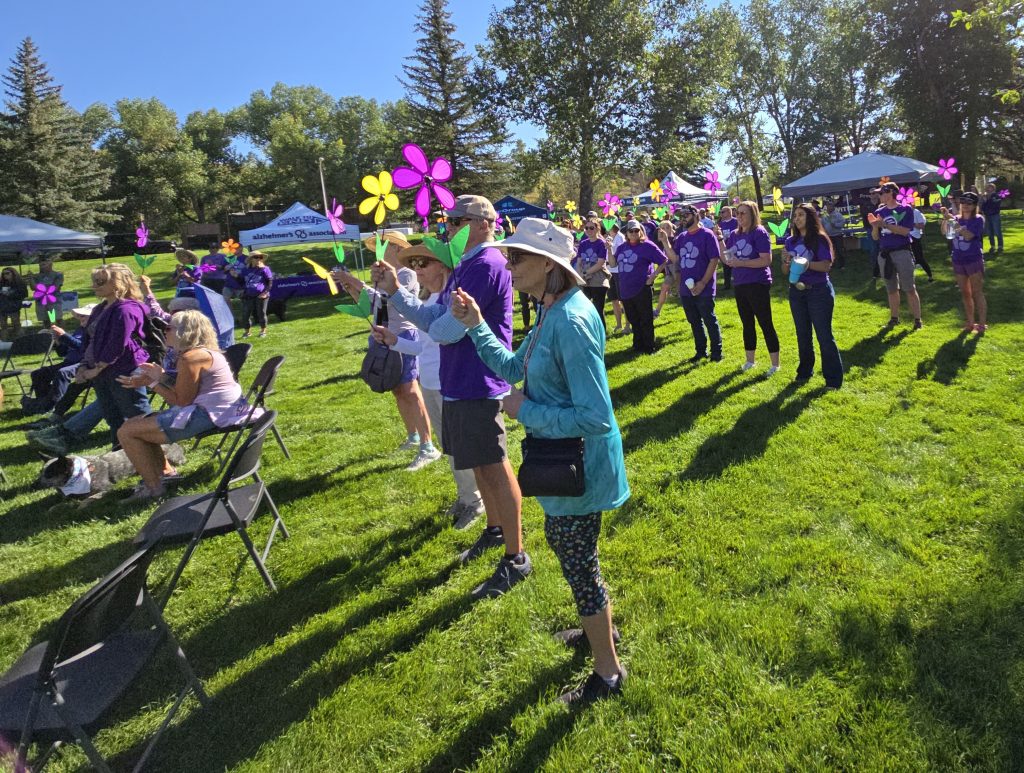
The annual Walk to End Alzheimer’s in Steamboat Springs is set for Saturday morning. The 1.4-mile community walk starts from West Lincoln Park.
In-person walk registration begins at 9 a.m., and group activities start at 10 a.m. with a Promise Garden Ceremony, followed by the walk. Each year participants walk carrying pinwheel flowers in colors representing patients, caregivers, supporters or people who have lost loved ones to the progressive and degenerative brain disease.
Beyond providing community information and support, the goal of the 2026 walk is to raise $30,500 for the nonprofit Alzheimer’s Association to assist with care, support and research efforts. The association provides free extensive resources for individuals and families faced with all types of dementia.
Pre-registration, information and volunteer opportunities for the fundraiser are online at Act.alz.org/Steamboat. Strollers and well-behaved dogs on leash are welcome at the walk. For questions, contact Kristi Dean at kldean@alz.org.











Support Local Journalism
Support Local Journalism
Readers around Steamboat and Routt County make the Steamboat Pilot & Today’s work possible. Your financial contribution supports our efforts to deliver quality, locally relevant journalism.
Now more than ever, your support is critical to help us keep our community informed about the evolving coronavirus pandemic and the impact it is having locally. Every contribution, however large or small, will make a difference.
Each donation will be used exclusively for the development and creation of increased news coverage.