What can working dogs tell us about how wolves are moving across the landscape?
Wild Ranch and Working Dogs for Conservation came together for 10 days in North Park in August to test a new idea to aid producers dealing with wolf-livestock conflict

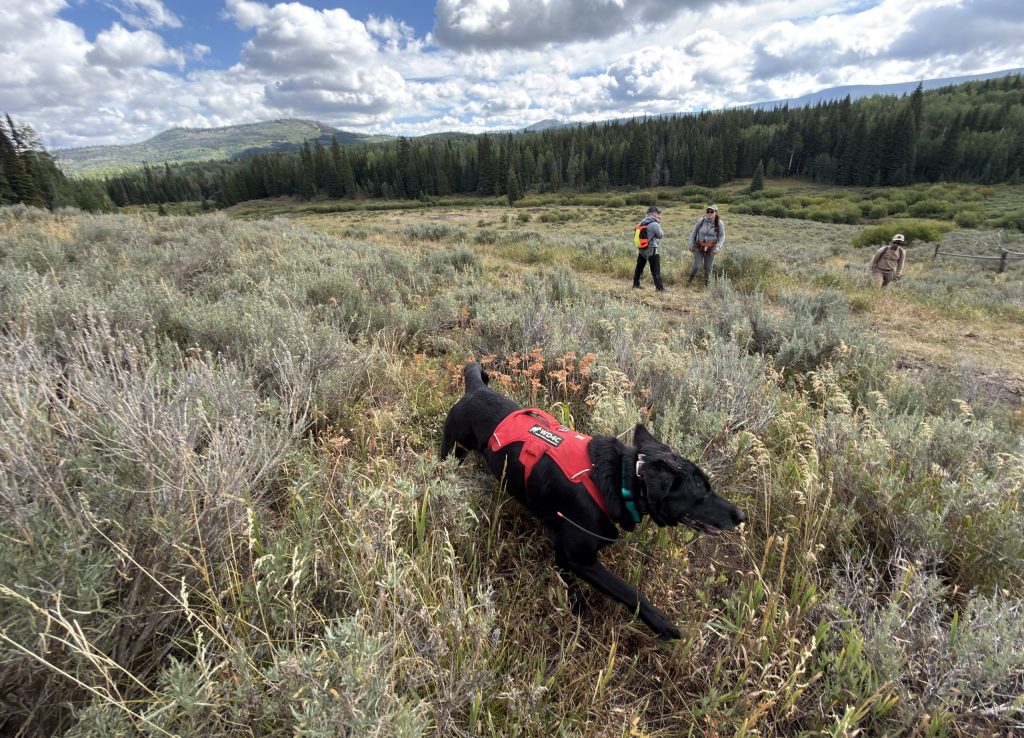
Chip Isenhart/Wild Ranch
As the One Ear wolf pack establishes a heavy presence near his family’s four-generation cattle ranch in North Park, Adam VanValkenburg estimates that he has spent hundreds of hours this summer just moving around game cameras, trying to understand where the wolves are.
It’s a number that doesn’t include the countless other hours VanValkenburg has spent deploying and exploring new nonlethal tools to keep the wolves away from their livestock, and it speaks to the immense need for producers to have information on where and how the cunning predators are using the landscape.
That’s where VanValkenburg hopes Charley, a 9-year-old Labrador trained by Montana-based Working Dogs for Conservation, can help fill in the gaps through an emerging pilot program called “Project Scout.”
For 10 days in August, North Park served as the initial testing ground for a concept between Working Dogs for Conservation and Wild Ranch, an organization started by Fraser resident Chip Isenhart to investigate new tools and approaches to addressing conflict between wolves and livestock.
The idea behind Project Scout — named for a rancher’s dog that was killed by wolves — is to determine whether dogs trained in wolf and wildlife detection could conduct “odor landscape mapping,” providing producers with information about wolf activity that can be used to target nonlethal deterrents more efficiently.
“This season was so difficult to figure out up in North Park,” Isenhart said, adding that the One Ear pack had new den and rendezvous sites, were in new areas and they could not find the pack’s travel paths. “They are so cagey and savvy and smart — we’re dealing with the world’s most resilient and brilliant pack apex hunter — and it’s a tough nut to crack.”
While Isenhart said Colorado Parks and Wildlife provides some information and “very, very coarse, grained data” on wolf locations, he likened using it to “reading tea leaves.”
“We found this very talented group in Montana,” Isenhart said. “… The idea was, could we bring out a dog that’s trained to find scat and look intensively at other areas of interest where that dog’s behavior changes?”
With Project Scout, the goal is to map the landscape from the canine’s perspective, including detecting and identifying wolves’ travel corridors, scent-marking locations, landscape funnels, fence crossings and areas of repeated use that may influence interactions between wolves and livestock.
The testing group also included Jes Lefcourt — founder of Earth Ranger, a software company that integrates wildlife and animal data in a unified platform — who helped set up the mapping and data side of the pilot.
Charley was trained by the Montana nonprofit to detect and discern the difference between coyote, wolf and bear scat.
“While [Charley] was making the rounds, he had a cell phone and tracking device on him that was mapping where he went,” VanValkenberg said. “After we were done, we were able to pull up the map and follow the hot spots where he showed the most interest and were able to focus on those areas with deterrents and human presence.”
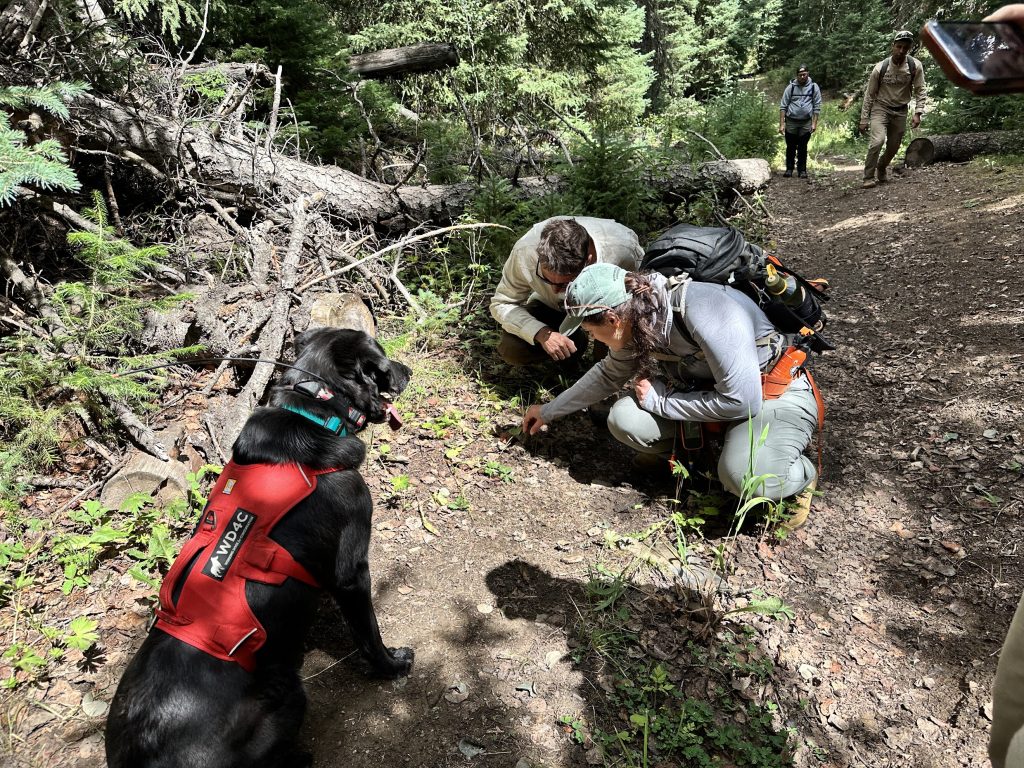
VanValkenberg said he was “surprised at how quickly he was on the trail.”
“[Charley] listened to the handler and stayed close by running in circles while she was walking through an area wolves were known to travel,” VanValkenberg said. “While we were walking through the timber, he also alerted us to coyote scat and several piles of bear scat, some of which were years old.”
Rocky Mountain Wolf Project — which led the effort to reintroduce wolves in Colorado and has supported Wild Ranch’s work with two grants — was among the stakeholders on site.
Courtney Vail, the organization’s board chair, said she experienced “collaboration, steps toward openness and trust, and the power and potential of a new tool to support an existing array of tools and approaches available to producers to strategically map the movements of wolves on landscapes shared with livestock.”
Early in its ideation, Project Scout still has lingering questions, including bigger ones like whether it is scalable for large landscapes or could be used in other wolf-conflict prevention programs. It also includes more minutiae questions about what training would be required, what breeds of dogs would be best, and more.
Vail said she thinks the idea carries tremendous potential.
“The track record of these working dogs domestically and internationally in mapping the movements and locations of other species is impressive,” Vail said. “… Furthermore, the individuals behind the program are motivated by the potential for success rather than the possibility for failure as new tools are being tested and explored on the unique and challenging landscapes of Colorado.”
VanValkenburg said that having a dog find this information would “cut down on the amount of time a producer would have to spend to find these areas” walking around and looking for tracks, giving them more time and the ability to “deploy tools and range riders more effectively.”
“[Range riders] are out there doing their very best to keep wolves out of our cattle and spend most of their time trying to find where the wolves came from and where they are going,” VanValkenberg said. “Having a dog being able to find that in a short amount of time will allow them to focus their energy more on hazing than trying to find travel corridors.”
Isenhart hypothesized that the enthusiasm around the idea and pilot was in part because it uses dogs, but also because it’s something new.
“Any new tool in the making gets interest, given that we’re really dealing with a similar set of tools since wolves were returned to Yellowstone 30 years ago,” he said. “So it’s frustrating for a lot of people that more progress hasn’t been made in different areas of wolf detection and deterrents. So I think it’s hopeful, it’s encouraging and people are excited to explore a new tool this way.”
A need for new methods of understanding, mitigating wolf-livestock conflict

The promise of the odor landscape mapping idea fits well into Wild Ranch’s other work.
“It doesn’t replace anything; it’s not a silver bullet, but it does help increase the efficiency and the utility of these other tools,” he said. “… Every property is so different, and every situation with wolves seems to be so different, so being able to have a suite of these tools at your disposal and have them complementing each other in their deployment is something that we really look at.”
VanValkenburg’s ranch has experienced wolf activity since before the voter-mandated reintroduction began in December 2023, tracking back to 2020 when Jackson County became home to a breeding pair that moved south from Wyoming. For the last year or so, he has been working with Wild Ranch to test several innovative ways to mitigate and reduce conflict between livestock and wolves.
“I started working with Chip because he had brought forward ideas that seemed to be a better fit for the terrain and circumstances of our summer pasture,” Vanvalkenburg said. “Our cattle are at 10,000 feet in the summer and the dense timber and rough ground can make it a challenge to access most of the area.”
In addition to the recent pilot for Project Scout, this work has included camera traps, which use artificial intelligence to detect predators and trigger remote activation devices or RAD boxes that serve as solar-powered scare devices. It has also included tracking and biometric livestock tags that monitor cattle behavior, which can alert ranchers to predator behavior and activate the RAD boxes, and more.
VanValkenburg added that he saw some of these ideas as “a benefit because you can haze the wolves without having to be there and monitor your cattle at the same time.”
Dealing with the social challenge of wolves

Bigger picture, Isenhart’s goal with Wild Ranch is to develop tools that deal with another wolf-related conflict in Colorado.
“The urban-rural divide is super intense in Colorado, and was partly set up with wolves being reintroduced only on the Western Slope and not on the east slope,” Isenhart said.
Isenhart’s idea would be to allow individuals to directly contribute funds to the tools that help producers reduce conflict between livestock and wolves. “That does two things. It builds trust through transparency, and it builds a relationship between the donor and the recipient,” Isenhart said.
While Isenhart has seen its potential — through his other business, ECOSCommunications, which helped design a museum in Tanzania with a similar concept in the gift shop — he’s still working to get it off the ground in Colorado.
During the recent testing in North Park, Vail said it was hopeful to see the authentic and earnest collaboration between stakeholders, particularly given Rocky Mountain Wolf Project’s role in leading the ballot measure to reintroduce wolves.
“Having helped to bring wolves to the state, I feel that we bear the obligation to support ranchers during this transition,” Vail said. “I don’t think most ranchers hate wolves — I think that is a fabricated dichotomy that serves to perpetuate intolerance and hate toward wolves and each other. Hate or resentment is also a unifier, unfortunately, but so is collaboration toward a common goal.”
Bigger picture, Vail said that “the goal is to move forward — and working together to find solutions is a powerful way to get there.”
“Human relationships and collaboration will determine the long-term fate of wolves in Colorado, and what was displayed over this weekend in North Park represented the best of us,” she said.


Support Local Journalism
Support Local Journalism
Readers around Steamboat and Routt County make the Steamboat Pilot & Today’s work possible. Your financial contribution supports our efforts to deliver quality, locally relevant journalism.
Now more than ever, your support is critical to help us keep our community informed about the evolving coronavirus pandemic and the impact it is having locally. Every contribution, however large or small, will make a difference.
Each donation will be used exclusively for the development and creation of increased news coverage.