Steamboat Springs City Council green-lights further exploration of fire district consolidation
Voters could see November 2027 ballot measure
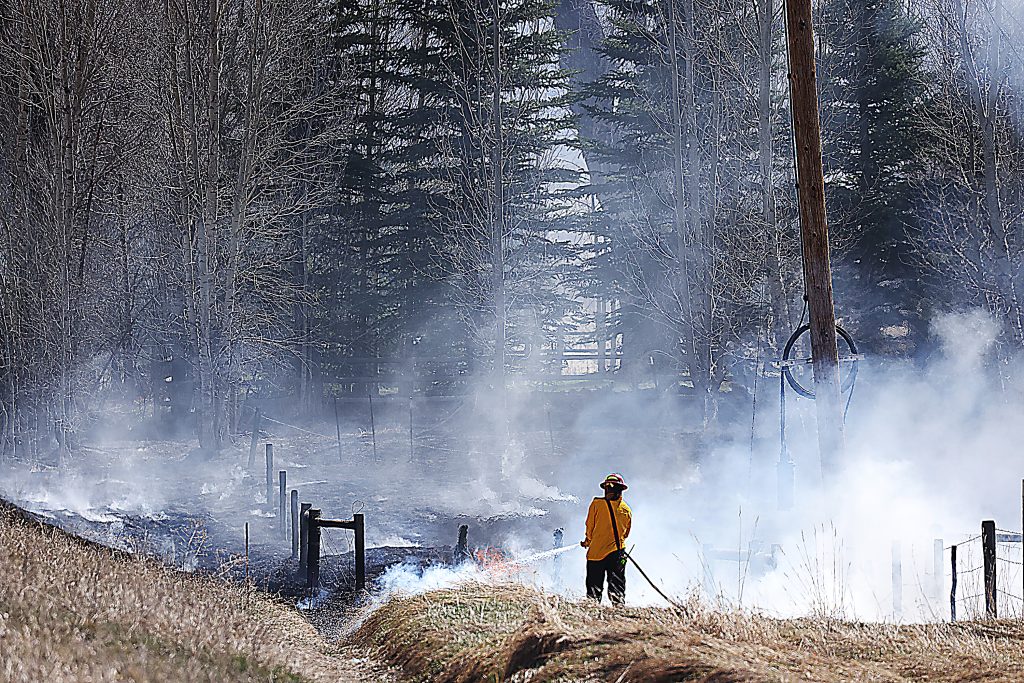
John F. Russell/Steamboat Pilot & Today
The Steamboat Springs City Council has unanimously endorsed further work on consolidating the city’s fire department into the Steamboat Springs Area Fire Protection District, a move both city and fire officials said could better align funding with service demands, improve wildfire readiness and create a more transparent governance model.
Steamboat Springs Fire Chief Chuck Cerasoli told council at their April 14 work session that the idea of consolidation — which has “lingered for many, many years” — has resurfaced due to rising call volume and service demands for the city’s fire rescue.
Steamboat Springs Fire Rescue currently serves the city’s 10 square miles, as well as the 380 square miles also covered by the fire district.
Cerasoli said annual calls have increased by about 4% annually over the past 20 years, while concurrent calls, or multiple incidents happening at once, have risen by about 5.62% per year since around 2011.
While he stressed that both the city’s fire department and the district have been “doing a great job” to expand their ability to meet higher service demands, the department is increasingly stretched when more than two calls come in at once.
“Currently, we have two fire stations that are each staffed with an ambulance and an engine,” he explained. “So for a lot of our basic calls, we can handle two calls at the same time.”
“Anything larger than a basic kind of medical call or fire alarm — a structure fire, a wildland fire, a hazmat incident, a multi-vehicle accident — that actually takes all of our crew, so all 10 people, to go to that call,” he continued. “In those situations, the second call-out does not get the adequate response we would like.”
He said the problem becomes more acute on third-call and higher responses, which average about 133 a year and can force the department to rely on mutual aid from neighboring districts that may take 20 to 30 minutes to reach Steamboat. That often means someone with a medical emergency is waiting an extra half-hour for a response.
“Compounding this is that we’re really an island here in Steamboat and Routt County as compared to a lot of areas,” he said, referencing Eagle Valley, which has 11 departments across the region that can coordinate resources among each other. “Our surrounding fire districts are actually also struggling themselves.”
“They’re losing a lot of their volunteers, and every time we ask them to cover our area — which we do quite a bit — then they’re saying, ‘Okay, are we okay with leaving our town uncovered?'” he added.
Fiscal sustainability pressures
Cerasoli framed consolidation as part of a larger fiscal challenge: the city’s current fire budget is about $8.6 million, but its strategic plan projects that figure could grow to $12.6 million by 2029 if the department is fully implemented.
He also pointed to $9.1 million in capital equipment needs between 2027 and 2034, plus potential station costs in that timeframe of $24.1 million for the Mountain Fire Station and $21.5 million for the West Steamboat Station.
He said the city already funds the department with roughly $4.1 million per year from the general fund — of which 60% is composed of sales-tax revenue — and a 2-mill property tax that generates a little more than $2 million annually, but that 2-mill revenue is expected to be fully consumed by operating costs within a few years.
The nod toward consolidation stands amid the backdrop of Steamboat’s broader fiscal sustainability issues due to its overreliance on tourist-driven sales tax revenue.
City Manager Tom Leeson noted that if the city did not want to move forward with consolidation, or if it did not pass the voters, “it is highly likely that we would be going to the voters and asking them for 4 or 5 mills just to fund the future growth.”
“Either way, I think the city residents are going to be paying more for future fire services than they are now by quite a bit,” Leeson added.
Cerasoli stressed that the proposal is not a fire authority or a new intergovernmental agreement. Instead, it would annex the city’s residents and territory into the existing fire district, creating one fire district, one governing board and one dedicated funding stream.
That model, he said, would better align the revenue stream with the service provided.
“If you’re primarily funded by property tax, you are funding a service that is protecting life and property directly,” said Cerasoli. “So there’s a little bit more alignment there than doing it through primarily sales tax.”
He also noted Colorado Senate Bill 24-194, which authorizes fire districts to ask voters for sales tax and/or impact fees to fund fire service — a funding tool that has already been used by several districts since the bill was passed in 2024, including the Oak Creek Fire Protection District’s implementation of impact fees in 2025.
While Cerasoli noted a similar conversation about consolidation back in 2018, he said the “political environment” has changed since, both in regards to the Gallagher Amendment, which was repealed in 2020, and the adoption of SB 24-194.
“The Gallagher Amendment was in full play, which meant really the commercial property owners were going to pay four times more than residential property owners,” he explained. “Quite honestly, a lot of the commercial property owners were concerned about the increase from 0-9 mills and the effect on their taxes — and they came out, vocally.”
Concerns and tradeoffs
The biggest downside, Cerasoli said, is that the city would give up direct control of fire governance. The elected district board would take over oversight, hiring and policy decisions, though the fire department itself already operates as a single department today.
He also said any transition would require work on personnel, benefits, public education, ballot language and financial alignment between the city and district.
Another challenge is community perception: council and district leaders would need to convince residents they would still receive the same level of service after the change.
“If all the district did was ask the city voters if they wanted to join into the fire district and left it there, all the city voters would be going from a 2-mill property tax currently paid to the city, to 9.24 mills that the district currently collects,” said Cerasoli.
The oversight committee, he said, would dive into the appropriate number of mills, noting that “everybody is at least open to consideration that 9.24 mills might be too much.”
Councilor Amy Dickson asked why the city shouldn’t simply ask voters for a property tax, to which Cerasoli responded that a district model offers more transparency and avoids the perception that the city might “play the shell game” with fire dollars.
Council President Steve Muntean said the concurrent-call problem and wildfire readiness — especially with what Cerasoli noted as an “unprecedented” upcoming wildfire season — make the issue particularly urgent.
City Attorney Dan Foote noted that the mechanics would be complicated if the district wanted to lock in a lower tax rate politically, but that the tax itself could be imposed through annexation without a TABOR election, should voters approve joining the district.
Cerasoli said Colorado now has about 340 fire departments, roughly 260 of them fire districts, and that the trend in other mountain communities has been toward district consolidation, including Summit Fire and the Roaring Fork Valley.
Public comment in support of consolidation
The local firefighters’ union, through president Brian McGovern, said consolidation would strengthen fire and EMS service for Steamboat Springs and the surrounding area.
“Our community continues to grow, particularly with the expansion of urban housing projects and increased residential density,” he said. “As the development evolves, it’s important that fire and emergency services are positioned to effectively plan for these changes and provide consistent, reliable protection.”
Former councilor Joella West said the public has historically supported fire funding, but that the new proposal could be easier to sell because it bypasses long-standing distrust that some residents have had in city council’s handling of fire dollars.
“This is the first time I have seen our fire chief come up here and tell the council, ‘We really don’t have enough money to do what needs to be done going forward,'” she said.
“To me, that’s pretty shocking to hear, because that’s not how the fire department in this community has presented itself. It has always been, ‘We will make whatever you allot to us work,'” she added. “What we are hearing now is different, and I hope you are all paying attention to that.”
Randall Hannaway, president of the fire district, said growth in the region has accelerated dramatically since the late 1990s and warned that the community is approaching a tipping point in service demand.
“We were a little hurt last time. We spent a lot of money to drive down that road — I think $70,000 or $80,000 — so we only want to do it if the city is all-in,” he said, acknowledging that the process must run its course.
“I wish we could say, ‘Yeah, we could do it for 6 or 7 mills,’…but we don’t know what that would look like,” Hannaway continued. “Just know that we’re supportive. We think it’s inevitable.”
Council unanimously agreed to keep exploring consolidation and to let the fire oversight committee take the lead.
Cerasoli said the ideal target would be a November 2027 election, which would require work to begin soon on funding scenarios, polling, messaging and ballot language, including bringing on consultants.






Support Local Journalism
Support Local Journalism
Readers around Steamboat and Routt County make the Steamboat Pilot & Today’s work possible. Your financial contribution supports our efforts to deliver quality, locally relevant journalism.
Now more than ever, your support is critical to help us keep our community informed about the evolving coronavirus pandemic and the impact it is having locally. Every contribution, however large or small, will make a difference.
Each donation will be used exclusively for the development and creation of increased news coverage.