Colorado voters to decide fate of dueling income tax questions in November
A measure to cap the state’s flat income tax rate, and another to increase it for higher earners, have both qualified for the ballot

Robert Tann/Steamboat Pilot & Today
Editor’s note: This story has been updated to correct the date of the November general election.
Colorado voters will be asked conflicting questions about the state’s income tax rate on their November 2026 ballots.
Dueling measures have both qualified for the ballot, according to state officials. One would prevent the state’s current flat income tax rate from increasing, and the other would raise the rate for higher earners.
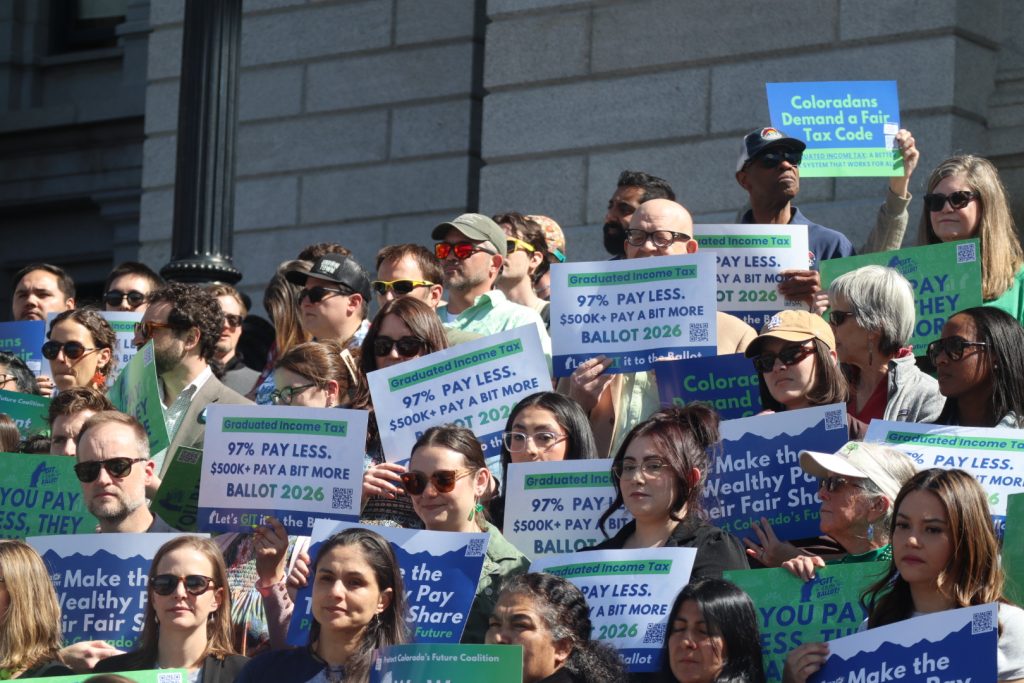
The latter, Initiative 195, is being led by a coalition of progressive groups and advocacy organizations calling themselves Protect Colorado’s Future. The Colorado Secretary of State’s office said on Tuesday, Sept. 1, that the campaign had submitted enough valid signatures to put their measure on the ballot.
If approved by voters, Initiative 195 would replace the state’s 4.4% tax rate — which applies to all taxpayers, regardless of income — with a graduated rate that would reduce taxes for some of the state’s lowest earners while ratcheting up taxes on those making $500,000 or more annually.
For a household making $95,470 — the state’s median income, according to U.S. Census data — the new rate would reduce annual income taxes by $316, according to a calculator on the coalition’s website.
The tax rate would increase to 7.4% for households earning over $500,000, and up to 8.4% for those earning $1 million or more. Under those changes, a household making $1 million annually would pay $15,925 more in income taxes, according to the coalition’s calculator.
The tax changes are expected to generate roughly $2 billion more in annual revenue, which the initiative would require the state to spend on healthcare, education and early childhood programs.
“Initiative 195 qualifying for the ballot means voters have the opportunity to create a fairer tax code that rebalances the scales,” said Christina Soliz, one of the campaign’s coalition co-chairs and executive director of New Era Colorado, in a statement. “This is our chance to build a state where the wealthy pay what they owe and where young people can actually see a future here.”
The other measure, Initiative 232, would cap the state’s income tax rate at 4.4%. It is led by Advance Colorado, a conservative advocacy nonprofit, and was approved for the ballot in August.
In a July 28 post on X, Advance Colorado President Michael Fields slammed the graduated tax proposal from progressive groups, writing that Coloradans “don’t want increased taxes on small businesses, seniors and veterans.”
Since the two ballot measures contradict one another, if both pass, the one that receives the most votes would go into effect. Both measures require a simple majority vote in favor to pass.
A third tax measure, Proposition NN, will also be on the November ballot after Democrats in the state legislature referred it to voters. If approved, the measure would allow the state to keep refunds issued under the Taxpayer’s Bill of Rights, or TABOR, to spend on K-12 education. It will be the third ballot proposal in seven years from Democrats seeking to overhaul TABOR, with measures in 2019 and 2023 both failing.
In total, 14 measures have qualified for the November ballot. Election Day is Nov. 3. Ballots will begin to be mailed to registered Colorado voters on Oct. 2.






Support Local Journalism
Support Local Journalism
Readers around Steamboat and Routt County make the Steamboat Pilot & Today’s work possible. Your financial contribution supports our efforts to deliver quality, locally relevant journalism.
Now more than ever, your support is critical to help us keep our community informed about the evolving coronavirus pandemic and the impact it is having locally. Every contribution, however large or small, will make a difference.
Each donation will be used exclusively for the development and creation of increased news coverage.